

Why Your Charity Needs an AI Policy, Like, Yesterday
Artificial intelligence (AI) isn't just for tech giants anymore; it's rapidly becoming an indispensable tool for charities of all sizes. From drafting compelling grant applications and analysing supporter data to automating routine tasks, AI offers incredible potential to boost efficiency, enhance impact and free up valuable staff time. However, this power comes with responsibilities, and without clear guidelines, charities risk missteps that could harm their beneficiaries, reputation, and funding prospects.
That's where an AI policy comes in. Think of it as your charity's roadmap for navigating the AI landscape safely and effectively. It's not about stifling innovation; it's about enabling informed, ethical, and compliant use of AI. Funders are increasingly asking about data protection and responsible technology use, and having a robust AI policy demonstrates your commitment to best practice and good governance.
This article will show you how to draft a practical, comprehensive AI policy for your UK charity or CIC in a single afternoon. Our goal is to equip you with a policy that trustees and staff can easily understand, and which reassures funders that your organisation is embracing AI responsibly.
Key Takeaways
- An AI policy is crucial for good governance, funder confidence, and safe AI use.
- Focus on six key sections: scope, permitted uses, prohibited uses, data protection, human oversight, and review.
- Keep it concise, practical, and easy to understand for all staff and trustees.
- Involve a small working group to draft, and trustees to approve.
- Regularly review and update the policy as AI technology evolves.
Demystifying the Dreaded Policy Document: What, Why, and Who?
Before we dive into drafting, let's clarify what an AI policy is, and why it's so important for your organisation.
What is an AI Policy?
In its simplest form, an AI policy is a set of internal guidelines that outlines how your charity will use artificial intelligence technologies. It covers everything from what tools are acceptable to how data should be handled, and who is responsible for ensuring compliance. It’s a living document, designed to evolve as technology and your charity's needs change.
Why is it Important for Charities?
- Risk Management: AI, while powerful, carries risks. Incorrect use can lead to biased outputs, data breaches, or even reputational damage. A policy helps mitigate these risks.
- Ethical Use: Charities operate on trust. An AI policy ensures your organisation uses AI ethically, aligning with your values and safeguarding your beneficiaries' interests.
- Funder Confidence: Funders are increasingly sophisticated. Demonstrating a proactive approach to AI governance signals professionalism and can enhance your funding applications.
- Staff Clarity: It provides clear boundaries and guidance for your team, encouraging safe and effective adoption of AI tools rather than discouraging their use altogether.
- Legal and Regulatory Compliance: While direct AI regulation is still developing, existing data protection laws (like GDPR) apply to AI use. A policy helps ensure compliance.
Who Should Be Involved?
While you might be drafting the initial version, an effective AI policy benefits from input across your charity. Involve a small group including a trustee (ideally the safeguarding or governance lead), a senior staff member (e.g., CEO, Head of Operations), and perhaps someone with practical experience using AI tools. Their diverse perspectives will ensure the policy is comprehensive and workable.
The Six Essential Sections of Your Charity AI Policy
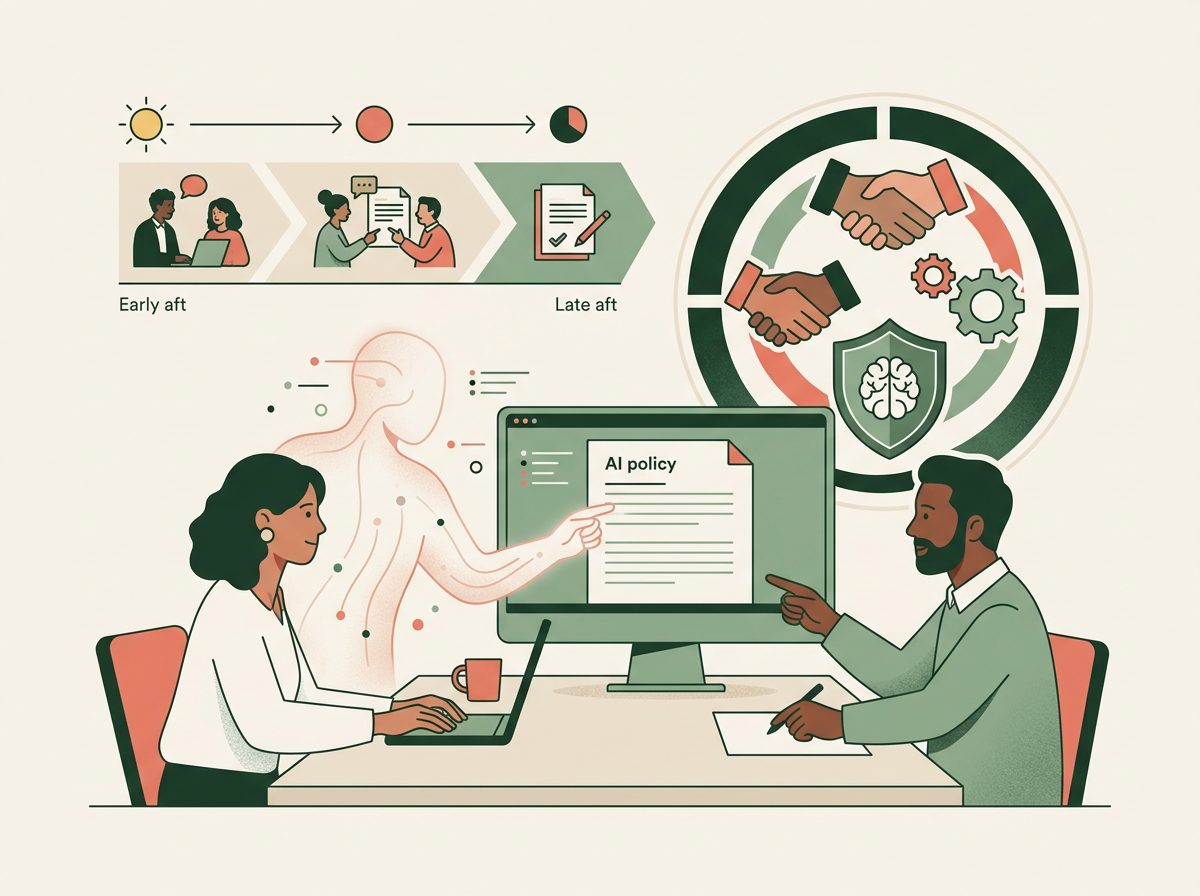
Every effective AI policy for a charity, regardless of its size, should cover six core areas. Don't overthink them; focus on clear, concise language.
1. Scope and Purpose
This section sets the stage. It defines what the policy covers (e.g., all staff, volunteers, trustees, and any AI tools they use) and its overarching goals. Keep it brief and to the point.
"This policy outlines our charity's commitment to the responsible, ethical, and effective use of Artificial Intelligence (AI) technologies across all operations. It applies to all staff, volunteers, and trustees, and aims to guide the adoption of AI tools in a manner that protects our beneficiaries, upholds our values, and maintains public trust."
2. Permitted Uses of AI
This is where you clarify the positive, beneficial ways AI can be used. Be specific but not exhaustive. This section encourages staff to explore AI's potential within safe boundaries.
- Drafting internal communications, meeting agendas, or routine emails.
- Summarising large documents, research papers, or reports.
- Generating initial ideas for fundraising campaigns or social media content (always requiring human review).
- Analysing anonymised supporter data to identify trends (with strict data protection protocols).
- Automating administrative tasks like scheduling or data entry.
3. Prohibited Uses of AI
Equally, if not more, important are the clear prohibitions. These are non-negotiable red lines. This section primarily focuses on safeguarding, data protection, and maintaining human accountability.
- Generating content that makes significant decisions about beneficiaries without human oversight.
- Inputting sensitive personal data (e.g., health information, financial details) into public or unapproved AI tools.
- Creating content that could be biased, discriminatory, or harmful.
- Using AI to impersonate individuals or provide medical, legal, or financial advice.
- Automating decisions that directly impact individual beneficiaries or staff without explicit human review and approval.
4. Data Protection and Privacy
A critical section for any charity, given the sensitive nature of the data often handled. This must align directly with your existing GDPR and data protection policies. Emphasise that AI tools do not override these obligations.
| Principle | Application to AI |
|---|---|
| Anonymisation | Prioritise using anonymised data for AI training or analysis whenever possible. |
| Consent | Ensure any data used by AI is processed with appropriate consent or lawful basis. |
| Vendor Security | Vet AI tool providers for their data security, privacy policies, and GDPR compliance. |
| Policy Overlap | AI policy must complement and reinforce existing data protection policies. |
| Sensitive Data | Strict prohibition on inputting sensitive personal data into general-purpose AI tools. |
Stress that staff must never input identifying information about beneficiaries, donors, or other individuals into public AI models, unless a specific, approved, and secure internal AI tool is used and fully compliant with data protection laws.
5. Human Oversight and Accountability
AI is a tool, not a replacement for human judgment. This section underscores the need for human involvement at crucial stages, ensuring accountability and preventing over-reliance on automated systems.
- Review and Verification: All AI-generated content (e.g., funding applications, external communications, decision-making insights) must be thoroughly reviewed, edited, and approved by a human before use.
- Decision-Making: AI outputs may inform, but never solely dictate, significant organisational decisions, especially those impacting individuals.
- Training and Awareness: Staff will receive training on responsible AI use, the limitations of AI, and how to identify potential biases or inaccuracies.
- Accountability: The individual using the AI tool remains ultimately responsible for its output and consequences.
6. Review and Updates
AI technology is evolving at an incredible pace. A policy drafted today might be outdated in a year. This section institutionalises regular review and adaptation.
- Review Frequency: The policy will be reviewed at least annually (or more frequently if significant AI developments occur or new tools are adopted).
- Reviewer: The Board of Trustees, in consultation with senior staff, is responsible for reviewing and approving policy updates.
- Feedback: Staff are encouraged to provide feedback on the policy and suggest areas for improvement as AI tools are tried and tested.
Bringing Your Policy to Life: Next Steps
Once you have a draft based on these six sections, here’s how to finalise it quickly:
- Circulate for Feedback: Share the draft with your small working group (trustee, senior staff, AI user) for their input. Aim for concise, constructive suggestions.
- Refine and Simplify: Edit for clarity and conciseness. Remove jargon. Two to three pages is ample for most small to medium-sized charities. The goal is readability and practicality.
- Board Approval: Present the policy to your Board of Trustees for formal approval. This elevates its status and ensures buy-in from your governance body.
- Communicate and Train: Once approved, disseminate the policy widely to all staff, volunteers, and trustees. Consider a short internal briefing or Q&A session to explain its purpose and answer initial questions.
- Lead by Example: Senior staff and trustees should actively demonstrate responsible AI use, reinforcing the policy's importance.
Next steps
Drafting an AI policy doesn't have to be an arduous task. By focusing on these six core sections and prioritising practicality and clarity, your charity can create a robust framework in a single afternoon. This proactive approach will not only safeguard your organisation and beneficiaries but also empower your team to harness AI's transformative potential responsibly, ultimately strengthening your charity's impact and appeal to funders.