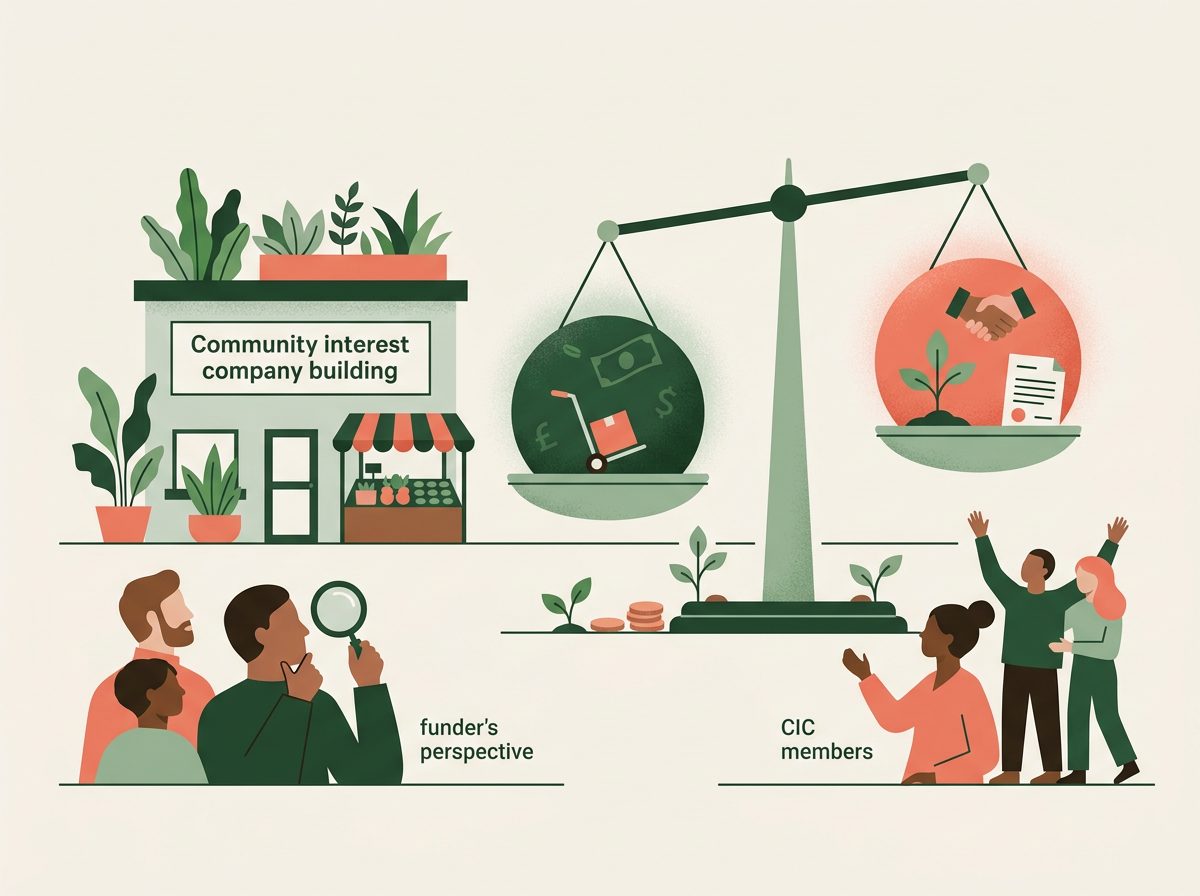
How much of a CIC's income should come from trading rather than grants, and what funders think about the balance.
Quick answer
There is no single right ratio, but most sustainable CICs aim for 40 to 70 percent trading income. Grants fund early-stage development, capacity and specific projects; trading pays for the business.
Navigating the Funding Landscape: Trading Income vs. Grants for CICs
For Community Interest Companies, or CICs, striking the right balance between trading income and grant funding is crucial for long-term sustainability and impact. There's often a misconception that grants are the primary, or even sole, source of funding for social good organisations. While incredibly important, relying too heavily on grants can create instability and divert focus from core mission delivery.
This article delves into the dynamic interplay between trading income and grants, offering practical insights for CICs, from those just starting out to established organisations looking to refine their funding strategy. We'll explore what funders are looking for, how to build a diverse income stream, and ultimately, how to achieve a healthy mix that underpins your social mission.
Key takeaways:
Aim for a trading income of 40-70% for long-term sustainability.
Grants are vital for start-up capital, project delivery, and capacity building.
Funders look positively at CICs with strong trading models and diverse income.
Balance financial resilience with your social mission.
THE ROADMAP1Navigating the FundingLandscape: Trading In2Understanding theDistinct Roles ofTrading3The "Right"Mix: What Funders Thin4Developing Your IncomeStrategy: Practical S5Challenges andConsiderationsHow this guide is structured
Understanding the Distinct Roles of Trading and Grants
To effectively manage your CIC's finances, it's essential to understand the different purposes that trading income and grants serve within your organisation.
Trading Income: The Engine of Sustainability
Trading income refers to money generated from selling goods or services, just like any other business. For a CIC, however, these activities are explicitly designed to further your social purpose. This can include anything from selling eco-friendly products, offering consultancy services, running workshops, or charging for access to facilities. The key distinction is that any profits generated must be reinvested into the CIC's mission or retained within the business for future activities.
Benefits of strong trading income:
Autonomy and Flexibility: Less reliance on external funders means more control over your strategic direction and operational decisions.
Sustainability: A robust trading model provides a consistent, predictable income stream, reducing vulnerability to grant cycles and changes in funding priorities.
Growth Potential: Reinvested profits can fund expansion, innovation, and increased impact without needing to constantly seek new grants.
Market Validation: If people are willing to pay for your services or products, it often indicates a genuine need and value in what you offer.
Grants: Fueling Impact and Innovation
Grants are non-repayable funds typically provided by charitable foundations, government bodies, or other institutions, to support specific projects, operational costs, or capacity building. For CICs, grants are often essential, particularly in the early stages or for discrete programmes that may not be easily self-funding through trading.
Illustration by Serin
When grants are particularly useful:
Start-up Capital: Grants can provide the initial funding to get a new CIC off the ground, covering essential set-up costs and early programme development.
Pilot Projects and Innovation: They are ideal for testing new ideas, developing innovative solutions to social problems, or running pilot programmes before they can become self-sustaining.
Core Costs and Capacity Building: Some grants specifically support organisational development, staffing, training, or infrastructure, which are vital for a CIC's health but often difficult to fund through trading directly.
Addressing Unmet Needs: Grants can fund services or interventions for vulnerable groups who cannot pay for them, ensuring your social mission reaches those most in need.
The "Right" Mix: What Funders Think and Why It Matters
While there is no universally prescribed ratio, many sustainable CICs aim for a significant portion of their income to come from trading. As a general guide, 40% to 70% of income from trading activities is often cited as a healthy range. However, this benchmark can vary depending on your CIC's sector, maturity, and specific mission.
"Funders want to see that your CIC has a clear plan for sustainability beyond their grant. A strong trading arm signals resilience and a commitment to long-term impact."
Why Funders Appreciate Trading Income
Funders are increasingly sophisticated in their assessment of not-for-profit organisations. They are not merely looking to fund projects, but to invest in sustainable solutions to social problems. A strong trading income model often indicates:
Reduced Risk: A diversified income stream means less reliance on a single funding source, making your CIC more robust and less vulnerable to external shocks.
Efficiency and Impact: If service users are willing to pay, even a token amount, it suggests the service is valued and effective. This can free up grant funds for more experimental or difficult-to-fund areas.
Growth and Scalability: Trading income can organically fund expansion, showing funders that their initial investment could lead to greater, self-funded impact down the line.
Business Acumen: It demonstrates that the CIC possesses strong leadership, strategic planning, and operational capabilities, which are attractive qualities to any investor, including grant-makers.
Funding Source
Primary Role for CICs
Funder Perception
Trading Income
Sustainability, Core Operations, Growth
Positive, indicating self-reliance and strong management
Grants (Project Specific)
Innovation, New Projects, Addressing specific needs
Essential, especially for early-stage or high-impact, non-commercial work
Grants (Core Costs)
Capacity Building, Strategic Development
Understood as critical, but often expected to diminish over time as trading increases
Developing Your Income Strategy: Practical Steps
Building the right funding mix is not a one-off task; it's an ongoing process that requires strategic planning and adaptation.
1. Assess Your Current Situation
Start by understanding your existing income streams. What proportion comes from trading, grants, donations, or other sources? Analyse the stability and predictability of each. This baseline will help you identify areas for improvement.
2. Identify Trading Opportunities Aligned with Your Mission
Brainstorm goods or services your CIC could offer that are directly related to your social purpose. Could you:
Offer training or workshops based on your expertise?
Sell products that embody your values (e.g., upcycled goods, ethical crafts)?
Provide consultancy services to other organisations in your field?
Charge for access to facilities or resources you already own?
Ensure these opportunities don't dilute or distract from your core mission. The most successful trading initiatives are those that enhance your impact.
3. Strategically Seek Grant Funding
Focus your grant applications on areas where they can have the most impact: seeding new initiatives, scaling proven programmes, or funding crucial but hard-to-monetise core costs. Be clear with funders about your long-term sustainability goals and how their grant fits into your broader income diversification strategy.
4. Build a Diversified Portfolio
Don't put all your eggs in one basket. Aim for a mix of larger, multi-year grants, smaller project grants, regular trading income, and potentially other sources like crowdfunding or individual donations. This diversification provides a safety net if one source diminishes.
Challenges and Considerations
While the benefits of a strong trading arm are clear, there are challenges to navigate:
Balancing Mission and Margin: It's crucial that commercial activities never overshadow or compromise your social mission. Keep your purpose at the forefront of all decisions.
Commercial Acumen: Developing trading activities requires different skills than grant fundraising. You might need to invest in market research, business planning, sales, and marketing.
Market Volatility: Trading income can fluctuate with economic conditions or market trends, requiring careful financial management and reserves.
Perception: Some stakeholders might question a 'not-for-profit' charging for services. Clear communication about the CIC model and reinvestment of profits is vital.
Next Steps
Rethinking your CIC's funding strategy is an ongoing journey. Start by analysing your current income, identifying potential trading opportunities, and engaging purposefully with grant funders. Remember, a robust, diversified income stream is the cornerstone of a resilient and impactful CIC.
Step-by-step
How to do this, step by step
Step 1
Assess Your Current Financial Mix
Begin by conducting a thorough audit of your CIC's income streams over the past 2-3 years. Categorise all income into grants, trading, donations, and other sources. Calculate the proportion of each. Understand the stability, predictability, and restrictions associated with each income type. This initial assessment provides a clear picture of your current reliance on different funding sources and highlights areas for potential diversification or strengthening.
Step 2
Identify Mission-Aligned Trading Opportunities
Brainstorm products or services your CIC could offer that directly advance or are complementary to your social mission. Consider your existing assets, expertise, and target beneficiaries. Could you charge for workshops, offer consultancy, sell mission-related products, or rent out spare capacity? Evaluate market demand, potential profitability, and the resources required to launch these trading activities. Ensure these ventures enhance, rather than detract from, your core purpose.
Step 3
Develop a Phased Income Diversification Plan
Create a strategic plan outlining how you will increase trading income and optimise grant funding over the next 3-5 years. Set realistic targets for the proportion of income from each source. This plan should include specific actions, timelines, and responsible individuals. For example, year one might focus on piloting one new trading service, while year three aims to scale that service and secure a multi-year grant for a new programme.
Step 4
Strengthen Grant Applications with a Sustainability Narrative
When applying for grants, ensure your proposals clearly articulate your long-term income diversification strategy. Explain how the requested grant funding will contribute to achieving greater sustainability, perhaps by funding the launch of a new trading arm, building organisational capacity, or piloting a project that could later become self-sustaining. Funders are increasingly looking for organisations with a clear path to reduced grant dependency.
Step 5
Invest in Commercial Skills and Resources
Recognise that developing trading income requires different skills than grant fundraising. This may involve investing in market research, business planning, marketing, sales, or customer service training for your team. Consider bringing in new expertise, even on a freelance or consultancy basis, to support the development and growth of your commercial activities. Adequate resourcing is crucial for the success of any new venture.
Practical examples
The Community Cafe and Training Programme
A CIC establishes a community cafe that sells locally sourced food and drinks. This trading income covers operational costs, salaries, and generates a surplus. Crucially, the cafe also serves as a training ground for young people facing barriers to employment, providing them with skills in hospitality, customer service, and food preparation. Grant funding supports the distinct training programme, paying for trainers, certifications, and support workers, while the cafe's trading income provides a sustainable, real-world learning environment and contributes to core overheads. This blended approach ensures both financial viability and maximum social impact.
Recycled Goods & Upcycling Workshops
A CIC is dedicated to reducing waste and promoting sustainable living. Their primary trading income comes from selling refurbished second-hand furniture and upcycled items, which are popular in the local community. They also offer DIY upcycling workshops, which are priced affordably to cover costs and contribute to profits. Grant funding is specifically sought for outreach programmes to local schools, where the CIC delivers free educational sessions on waste reduction and sustainability, a crucial part of their mission that wouldn't easily be funded through direct sales.
Common mistakes to avoid
Over-relying on a single grant funder, creating financial instability if that funding ends.
Developing trading activities that are not directly aligned with or distracted from the CIC's core social mission.
Failing to adequately budget for the time, skills, and investment required to develop and manage commercial activities successfully.
Not communicating clearly to stakeholders (beneficiaries, funders, and the public) why the CIC charges for services, if applicable.
Neglecting to build financial reserves from trading income, leaving the CIC vulnerable to unexpected costs or market fluctuations.
Underestimating the complexity of legal and tax implications for diverse income streams.
Having an unclear value proposition for trading offerings, leading to poor customer engagement.
FAQ
Frequently asked questions
What is the ideal ratio of trading income to grants for a CIC?+
There's no single 'ideal' ratio, as it depends on your CIC's age, mission, and sector. However, many sustainable CICs aim for 40% to 70% of their income to come from trading activities. Funders generally view a higher proportion of trading income as a sign of resilience and sustainability, while still recognising the vital role of grants for specific projects and capacity building.
Can CICs generate profit from trading activities, and what happens to it?+
Yes, CICs can generate profits from their trading activities. The key difference from commercial businesses is that these profits cannot be distributed for private gain (except for limited dividend caps, if applicable). Instead, all profits must be reinvested back into the CIC to further its social mission or retained within the business for future activities and reserves. This is a core part of the CIC's asset lock.
Do grants fund core costs, or just projects?+
Grants can fund both core costs and specific projects, but there's a growing trend among funders to prioritise project-based funding. However, many foundations understand the importance of healthy core funding for organisational resilience. When applying for core costs, it's often beneficial to demonstrate how these costs underpin your ability to deliver impactful projects and eventually increase your self-generated income.
How can a new CIC develop trading income when it's just starting out?+
For a new CIC, initial grant funding is often crucial for start-up costs and pilot projects. At the same time, begin evaluating simple, low-risk trading opportunities that directly relate to your mission. This could involve offering a basic service or product at a modest price. Start small, gather feedback, and gradually build your commercial capacity alongside your grant fundraising efforts. Demonstrating a clear plan for future trading income can also strengthen early grant applications.
Will having too much trading income deter grant funders?+
Generally, no. Most grant funders appreciate strong trading income as it demonstrates a CIC's sustainability and efficiency. It suggests their grant will be part of a robust, well-managed organisation. However, if your CIC becomes overwhelmingly commercial, and appears to have less need for charitable support, some funders (particularly those with strict charitable objectives) might prioritise organisations with less external income. It's about finding the right balance for your specific mission and funding landscape.
Serin funding intelligence
Get funding intelligence tailored to your organisation
Create your free Serin account to see funders matched to your organisation.