
Navigating Data Protection: A Practical Guide for UK Charities and CICs
Data protection might sound like a bureaucratic hurdle, but for UK charities and Community Interest Companies (CICs), it's a fundamental aspect of building trust, safeguarding vulnerable individuals, and operating legally. While the terminology – GDPR, ICO, lawful basis – can seem daunting, at its heart, data protection is about handling people's personal information responsibly and transparently. This guide breaks down the essentials into plain English, offering practical, actionable advice to help your organisation stay compliant without getting bogged down in jargon.
Many charities and CICs assume that compliance requires a dedicated data protection officer (DPO) or an extensive legal budget. The good news is that for most, this isn't the case. Instead, it’s about understanding a few key principles and embedding them into your day-to-day operations. This might involve creating a clear privacy notice, understanding why you're collecting certain data, or having a plan for what to do if data is accidentally disclosed. Getting these basics right is not only a legal requirement but also a powerful way to demonstrate credibility to your beneficiaries, donors, and partners.
Key Takeaways
- Every UK charity and CIC handling personal data must register with the ICO, usually for £40 per year.
- A clear privacy notice is essential, explaining what data you collect and why.
- You need a 'lawful basis' for every piece of personal data you process.
- Establish a written policy and process for handling data breaches.
- You probably don't need a dedicated Data Protection Officer (DPO).
The Cornerstone: Registering with the ICO
The very first step for almost every UK charity and CIC is to register with the Information Commissioner's Office (ICO). The ICO is the UK's independent authority set up to uphold information rights in the public interest, promoting openness by public bodies and data privacy for individuals. If your organisation processes personal data – which includes anything from supporter mailing lists to beneficiary records – you likely need to register.
This registration is not a one-off task; it's an annual commitment. Most charities and CICs will fall into 'Tier 1' or 'Tier 2' organisations, meaning the annual fee is typically £40 or £60. Failure to register can result in significant fines, and it's a quick, straightforward process that can be completed online. Don't be tempted to skip this vital step; it's the foundation of your data protection journey and signals your commitment to responsible data handling.
Establishing a Lawful Basis for Processing Data
Under the UK General Data Protection Regulation (GDPR), you cannot simply collect and use personal data without a legitimate reason. For every piece of personal data you process – whether you're collecting names for a newsletter, addresses for delivering services, or health information for support programmes – you must identify a 'lawful basis'. There are six main lawful bases, and understanding which one applies to specific activities is crucial.
The most common lawful bases for charities and CICs include:
- Consent: The individual has given clear consent for you to process their personal data for a specific purpose. This must be freely given, specific, informed, and unambiguous.
- Contract: The processing is necessary for a contract you have with the individual, or because they have asked you to take specific steps before entering into a contract.
- Legal Obligation: The processing is necessary for you to comply with the law (not including contractual obligations).
- Vital Interests: The processing is necessary to protect someone's life. This is rarely used in a charity context beyond emergency situations.
- Public Task: The processing is necessary for you to perform a task in the public interest or for your official functions, and the task or function has a clear basis in law. This often applies to public sector bodies but can sometimes apply to charities delivering public services.
- Legitimate Interests: The processing is necessary for your legitimate interests or the legitimate interests of a third party, unless there is a good reason to protect the individual's personal data which overrides those legitimate interests. This is often a flexible basis for charities but requires a careful balancing act and documentation.
Choosing the correct lawful basis is not a 'pick your favourite' exercise. It requires careful thought for each specific data processing activity. For instance, sending a general fundraising email might often be based on consent or legitimate interests, while processing payroll data for an employee is a contractual necessity.
"Effective data protection isn't just about avoiding penalties; it's about fostering trust. When beneficiaries and donors know their data is safe, they're more likely to engage and support your mission."
Serin Insight
The Importance of a Transparent Privacy Notice
Once you understand your lawful bases, the next step is to communicate this clearly to the individuals whose data you process. This is where your privacy notice (also known as a privacy policy) comes in. A privacy notice is a public document that explains how your organisation collects, uses, stores, and protects personal data. It must be easily accessible, written in plain language, and comprehensive.
Crucially, your privacy notice should include:
- Your organisation's identity and contact details.
- The types of personal data you collect.
- The purposes for which you are processing the data.
- The lawful basis for each processing purpose.
- Who you share the data with (e.g., third-party service providers).
- How long you will retain the data (data retention policy).
- Information about individuals' rights (e.g., right to access, rectify, erase data).
- How individuals can complain to the ICO.
Placing your privacy notice prominently on your website is standard practice. For data collected offline, such as on paper forms, you should either provide the full notice or a clear summary with instructions on how to access the complete version.
Data Retention and Secure Disposal
Holding onto personal data for longer than necessary is a common pitfall and a breach of data protection principles. Your organisation needs a clear data retention schedule that specifies how long different types of data will be kept and why. This schedule should be based on legal requirements, regulatory guidance, and business needs.
For example, financial records often need to be kept for six years for HMRC purposes, while consent for marketing might need to be refreshed more frequently. Once data is no longer needed, it must be securely disposed of. This means more than just deleting files from your computer; it includes shredding paper documents, securely wiping hard drives, and ensuring data is unrecoverable. Documenting your retention schedule and disposal methods demonstrates your commitment to responsible data management.
Preparing for the Worst: The Data Breach Process
Despite all precautions, data breaches can happen. A data breach is not just a hacker gaining access to your systems; it's any accidental or unlawful destruction, loss, alteration, unauthorised disclosure of, or access to, personal data transmitted, stored, or otherwise processed. This could be something as simple as sending an email to the wrong person, a laptop being stolen, or a paper file being misplaced.
Every charity and CIC must have a written process for identifying, responding to, and reporting data breaches. This process should outline:
- Who is responsible for handling breaches.
- How to identify a potential breach.
- Steps to contain the breach (e.g., isolate systems, recover lost data).
- Assessment of the risk to individuals' rights and freedoms.
- When and how to report the breach to the ICO (within 72 hours if there's a risk to individuals).
- When and how to inform affected individuals.
- Post-breach review and learning.
Having this process in place and understood by staff is crucial. Timely reporting to the ICO can mitigate potential penalties and demonstrates your proactive approach to data security.
Do You Need a Data Protection Officer (DPO)?
A common misconception among charities and CICs is that they are legally required to appoint a Data Protection Officer. For most, this is not the case. You only need a DPO if you are a public authority or body (which typically doesn't include most charities, unless they're performing a public task based on law), or if your core activities consist of processing operations which require regular and systematic monitoring of data subjects on a large scale, or if your core activities consist of large-scale processing of special categories of data or data relating to criminal convictions and offences.
For the vast majority of UK charities and CICs, a DPO is not mandatory. Instead, you can designate a responsible individual or team to oversee data protection compliance. This person should have a good understanding of GDPR principles and practical application, and be given adequate resources and authority to carry out their role effectively.
Practical Steps to Enhance Your Data Protection
Beyond the fundamental requirements, there are several practical steps your organisation can take to strengthen its data protection posture and build a culture of privacy.
Staff Training
Your staff are your first line of defence. Regular, engaging data protection training is vital. It doesn't need to be complex; focus on practical scenarios relevant to their roles, such as handling emails, using secure passwords, and recognising phishing attempts. This empowers your team to be vigilant and adhere to best practices.
Data Protection Impact Assessments (DPIAs)
For new projects or technologies that might involve 'high risk' data processing – such as extensive use of sensitive personal data or new surveillance technologies – you should conduct a Data Protection Impact Assessment (DPIA). This helps you identify and minimise data protection risks upfront, before they become problems.
Supplier Due Diligence
When you use third-party suppliers (e.g., CRM systems, email marketing platforms, cloud storage), you remain responsible for the data they process on your behalf. Always conduct due diligence to ensure they are GDPR compliant, and have a written contract (Data Processing Agreement) in place that outlines their responsibilities and your expectations regarding data security.
Regular Reviews
Data protection is not a 'set and forget' task. It requires ongoing attention. Regularly review your policies, procedures, and practices. Are they still relevant? Are there new technologies or activities that require updates? An annual review, or a review triggered by significant changes, is good practice.
| Area | Action Points | Notes for Charities/CICs |
|---|---|---|
| ICO Registration | Annual check, pay fee | Essential first step, usually £40/£60 for Tiers 1 & 2. |
| Privacy Notice | Accessible, clear, comprehensive | Review yearly, ensure it reflects all data processing. |
| Lawful Basis | Document for each data type/activity | Crucial for demonstrating compliance. Use assessment tool if unsure. |
| Data Retention | Written schedule, secure disposal methods | Avoid holding data longer than necessary; shred/wipe securely. |
| Breach Process | Defined steps for identification, containment, reporting | Train staff, understand 72-hour reporting rule for high-risk breaches. |
Next Steps
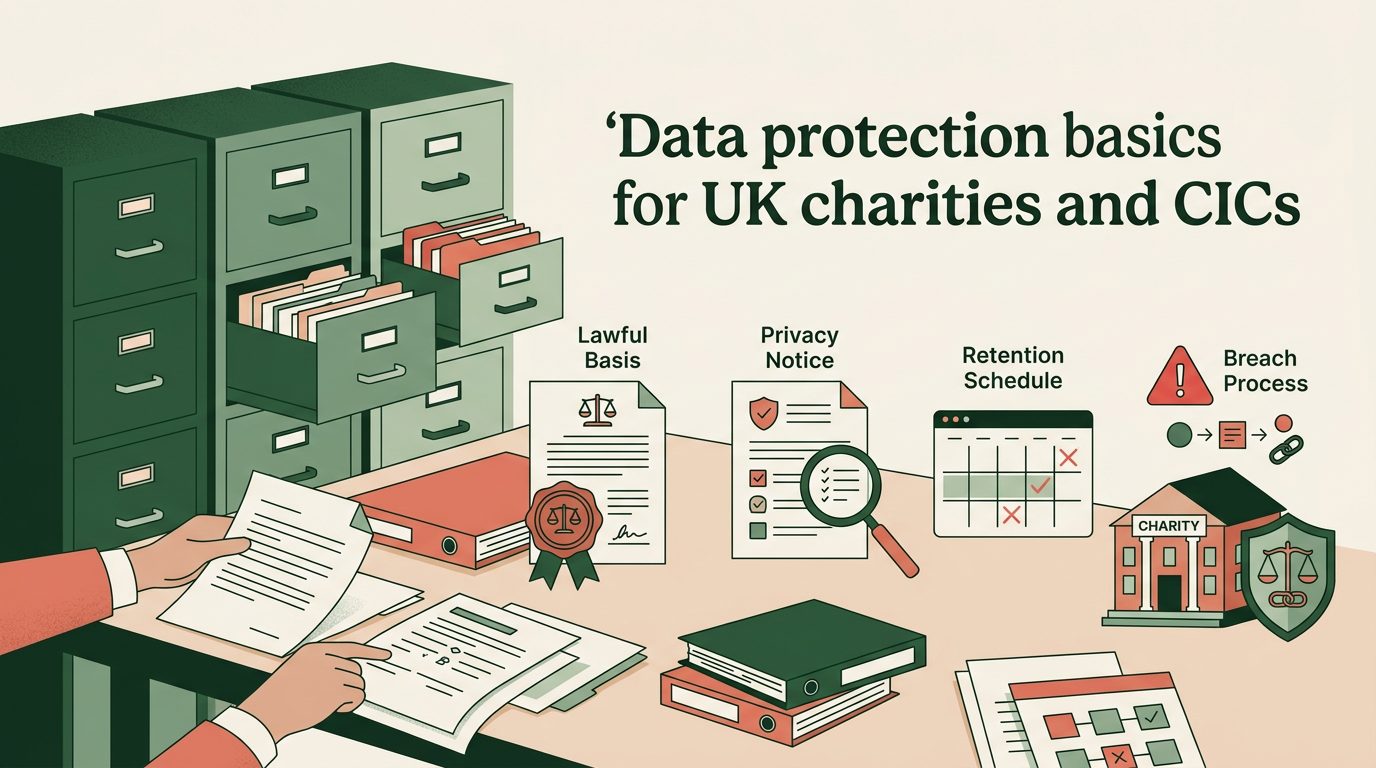
By focusing on these core areas – ICO registration, lawful basis, privacy notices, retention, and breach processes – your charity or CIC can build a robust and compliant data protection framework. While the landscape of data protection might evolve, the fundamental principles of transparency, accountability, and respecting individuals' rights remain constant. Start with an internal audit of your current data handling practices, identify areas for improvement, and implement changes incrementally. Remember, good data protection is a journey, not a destination, and a continuous commitment will serve your organisation and its stakeholders well.