
Key Takeaways
- Diversifying your funding across at least three income streams significantly boosts resilience.
- Building strong, ethical relationships with funders and supporters is paramount, regardless of the income source.
- Understanding the nuances of each funding type helps tailor your engagement strategies effectively.
- A proactive and strategic approach to funding, planning for future trends, is crucial for long-term sustainability.
- Charities must balance income generation with their mission, ensuring funding aligns with values and impact.
For any UK charity or Community Interest Company (CIC), securing a stable and diverse funding base is not just good practice, it's essential for survival and growth. In 2026, the landscape of charity funding continues to evolve, presenting both opportunities and challenges. Understanding where money comes from, and how to blend different sources effectively, is a cornerstone of a resilient organisation.
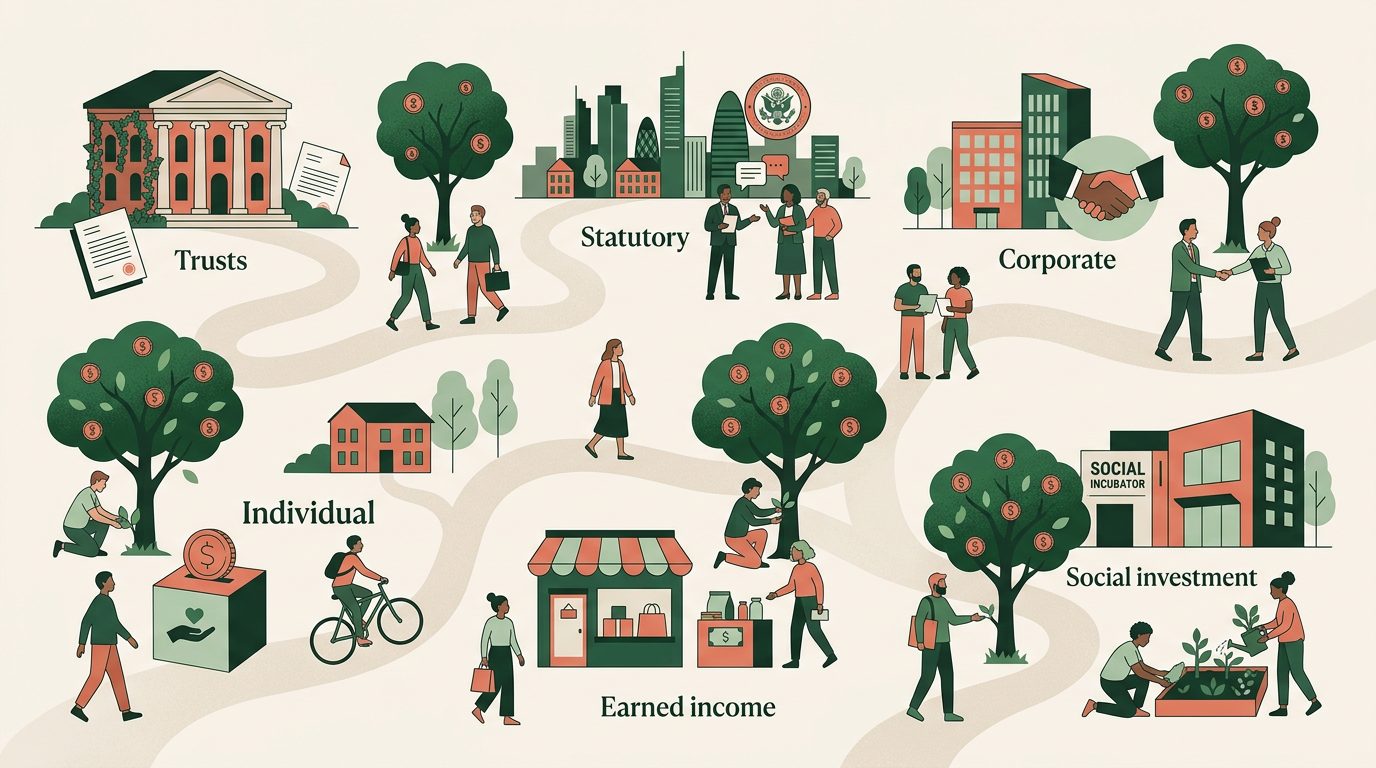
This guide delves into the six primary avenues for charity funding in the UK: trusts and foundations, statutory contracts, individual giving, corporate partnerships, earned income, and social investment. We'll explore the characteristics of each, offer guidance on how to approach them, and discuss how to weave them together into a robust financial strategy.
Understanding the Funding Landscape: A Blended Approach
Gone are the days when relying on a single funding stream was a sustainable model. Economic shifts, changes in donor priorities, and evolving government policies mean that organisations must be agile and adaptable. A 'blended' funding approach, much like a well-diversified investment portfolio, spreads risk and creates pathways for innovation and stability.
Research consistently shows that charities with multiple income sources are better equipped to weather crises and pursue their long-term objectives. This isn't about chasing every pound available; it's about strategically identifying the best fit for your mission, capacity, and impact goals. The key is to build a funding mix that complements your operations and values, rather than dictating them.
"Diversification isn't just about survival; it's about unlocking potential. A blended funding strategy allows charities to innovate, scale and deliver greater impact without being solely dependent on one income stream."
Trusts and Foundations: The Benevolent Backbone
Trusts and foundations remain a fundamental source of income for thousands of UK charities. These philanthropic organisations, set up by individuals, families or corporations, typically award grants to support specific projects, core costs, or capacity building. Their appeal lies in their potential to provide significant, often unrestricted, funding and their willingness to support innovative initiatives.
Approaching trusts and foundations requires careful research and a tailored approach. Each trust has its own focus, eligibility criteria, and application process. Building relationships, even if initially distant, can be beneficial, but the primary interaction is usually through a well-crafted grant application. Success in this area hinges on clearly articulating your need, your proposed solution, and your anticipated impact, all while aligning with the funder's charitable objectives.

Statutory Contracts: Delivering Public Services
Statutory funding, primarily from central government departments, local authorities, or devolved administrations, involves contracts to deliver specific services or projects. This often means tendering for work, where charities compete with other organisations, including private companies, to provide services that meet public needs. For many charities, particularly those engaged in social care, education, or environmental services, statutory funding forms a substantial part of their income.
While statutory contracts can offer large, predictable income streams, they come with significant responsibilities and often stringent reporting requirements. Charities must have robust governance, financial management, and service delivery systems in place. Understanding the commissioning cycle, demonstrating value for money, and proving direct impact are crucial for success in this highly competitive arena.
Individual Giving: The Power of the People
Individual giving encompasses donations from members of the public, ranging from small, regular contributions to large one-off gifts and legacies. This is often the most emotionally driven form of funding and represents the broad support a charity has from its community. Techniques include direct mail, online fundraising, community events, payroll giving, and remembrance donations.
Cultivating individual donors requires a strong narrative, transparency about impact, and consistent communication. Building a loyal donor base is a long-term endeavour, focusing on engagement, stewardship, and demonstrating how their contributions make a tangible difference. Digital fundraising channels continue to grow in importance, making accessible and compelling online campaigns vital for reaching a wider audience.
Corporate Partnerships: Aligning Values and Impact
Corporate partnerships involve collaborations between charities and businesses. These can take many forms, including corporate social responsibility (CSR) initiatives, employee fundraising, cause-related marketing, sponsorship, and grants from corporate foundations. Businesses often seek to align with charities that resonate with their brand values, engage their employees, or contribute to their community investment goals.
Successful corporate partnerships are mutually beneficial. Charities gain financial support, access to skills, and increased visibility, while businesses enhance their reputation, meet CSR objectives, and engage their workforce. Building these relationships requires professionalism, a clear value proposition, and the ability to demonstrate tangible outcomes that align with the company's objectives. A well-structured proposal that outlines the mutual benefits is often the starting point.
Earned Income: Sustainable Commercial Activities
Earned income refers to money generated through the sale of goods or services directly related to a charity's mission, or through commercial activities that support its charitable purpose. Examples include fees for training courses, tickets for events, sales from charity shops, ethical trading initiatives, or renting out facilities. This stream is particularly attractive as it offers a degree of financial independence and sustainability, reducing reliance on donations.
Developing earned income streams requires a business-minded approach, including market research, pricing strategies, and effective marketing. It also necessitates a clear understanding of charity law regarding trading activities to ensure all operations comply with regulations and remain focused on advancing the charity's mission. Balancing commercial acumen with charitable ethos is key to success.
Social Investment: Capital for Growth and Impact
Social investment involves providing finances to organisations with the explicit expectation of a social, as well as a financial, return. This isn't traditional grant funding; it's often in the form of loans, equity, or quasi-equity. Social investment is designed for charities and social enterprises that need capital to grow their operations, develop assets, or become more financially sustainable through income-generating activities.
Accessing social investment requires a robust business plan, a clear theory of change, and the capacity to repay loans or provide a return on investment. It's a growing area in the UK, with specialist social investors and funds designed to support organisations that are generating positive social impact alongside a recoverable financial model. This option is best suited for charities with established income streams or those looking to invest in new, income-generating projects.
| Funding Source | Typical Duration | Key Application Factors | Common Challenges |
|---|---|---|---|
| Trusts & Foundations | 1-3 years (project-based) | Alignment with mission, clear impact | High competition, specific criteria |
| Statutory Contracts | 3-7 years (service delivery) | Value for money, demonstrable capacity | Bureaucracy, performance metrics |
| Individual Giving | Ongoing (relationship-based) | Compelling story, donor stewardship | Donor fatigue, communication costs |
| Corporate Partnerships | 1-5 years (strategic alliance) | Mutual benefit, brand alignment | Finding the right fit, measuring ROI |
| Earned Income | Ongoing (commercial activity) | Market demand, operational efficiency | Business acumen, market fluctuations |
Building Your Blended Funding Strategy
Developing a successful blended funding strategy requires internal assessment and external analysis. Start by looking at your organisation's strengths, weaknesses, opportunities, and threats (SWOT analysis). What are your most compelling projects? What resources do you have internally? Where are the gaps in your current funding?
Consider the long-term trends affecting your sector and the broader economic environment. Engage your board and senior leadership in strategic discussions about where your funding should come from in the next three to five years. Don't be afraid to innovate and explore new avenues, but always ensure they align with your charitable objectives and capacity.
- Assess your current funding mix and identify areas of over-reliance.
- Research potential new funding streams that align with your mission.
- Develop clear fundraising targets for each income stream.
- Invest in the skills and resources needed to pursue new opportunities.
- Foster a culture of fundraising and income generation across the organisation.
- Regularly review and adapt your strategy based on performance and external factors.
Next Steps
The journey to a robust and diversified funding base is continuous. By strategically exploring and integrating these six key income streams, UK charities and CICs can build greater resilience, foster innovation, and ultimately deliver more profound and lasting impact. Start by evaluating your current position, identifying realistic new avenues, and investing in the relationships and skills that will drive your fundraising success into 2026 and beyond.