
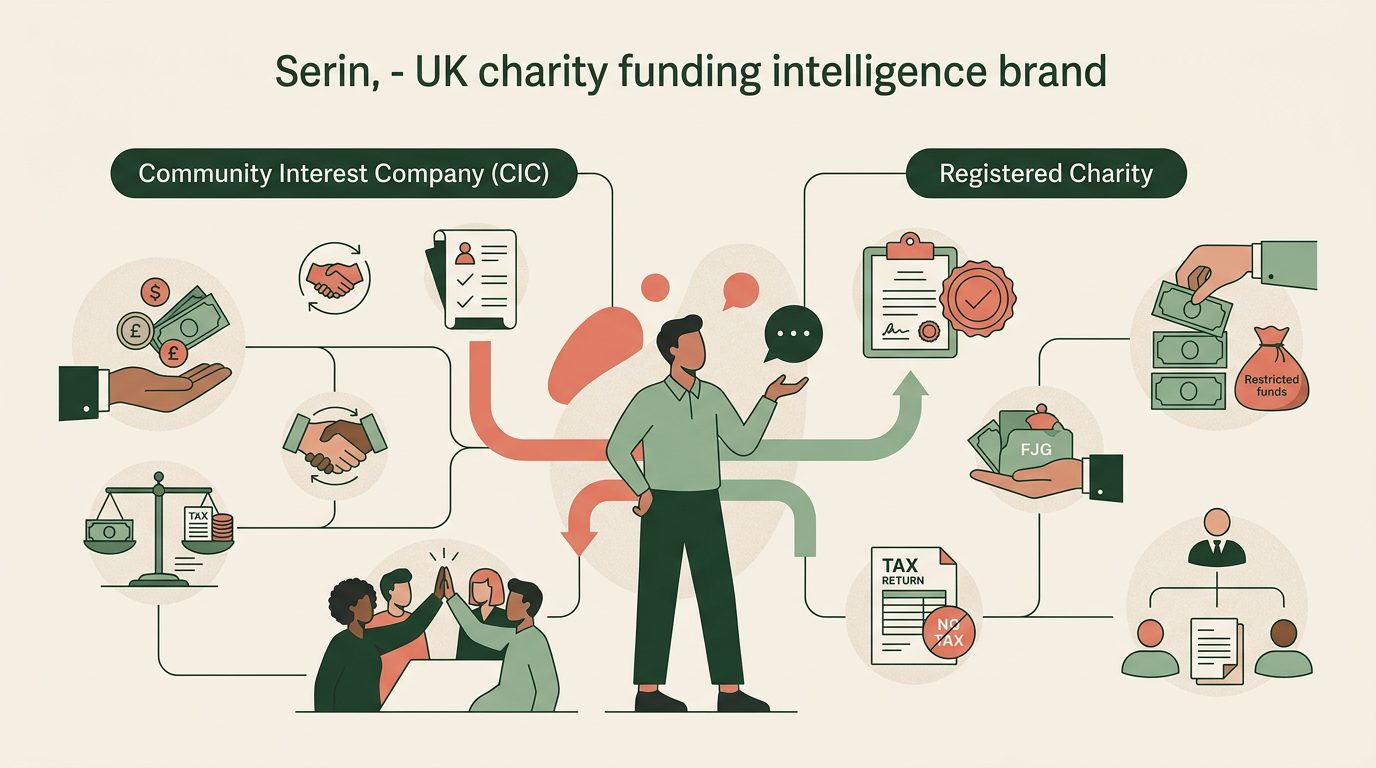
When you are looking to set up an organisation that does good work in the community, one of the most fundamental decisions you will make is choosing its legal structure. In the UK, two of the most popular options for social purpose organisations are Community Interest Companies (CICs) and registered charities. While both aim to benefit society, they differ significantly in their legal frameworks, regulatory requirements, funding opportunities and operational freedoms.
Getting this decision right from the outset is crucial, as it impacts everything from how you raise money to how you govern your organisation and even how you manage your long-term legacy. This comprehensive guide will walk you through the key differences, helping you understand which structure is best suited for your vision and operational model.
Key takeaways for quick reference:
- Purpose is paramount: CICs primarily trade for social benefit, while charities primarily fundraise for public benefit.
- Funding access: Charities generally have wider access to grant funding and can claim Gift Aid; CICs rely more on trading income and social investment.
- Regulation: Charities face stricter regulation from the Charity Commission; CICs have lighter regulation from the Regulator of Community Interest Companies.
- Asset lock: Both structures have an asset lock, meaning assets must be used for community benefit and cannot be distributed to members or directors.
- Financial benefits: Charities benefit from a broader range of tax reliefs, including exemption from Corporation Tax on most income and gains, and business rate relief.
Understanding Community Interest Companies (CICs)
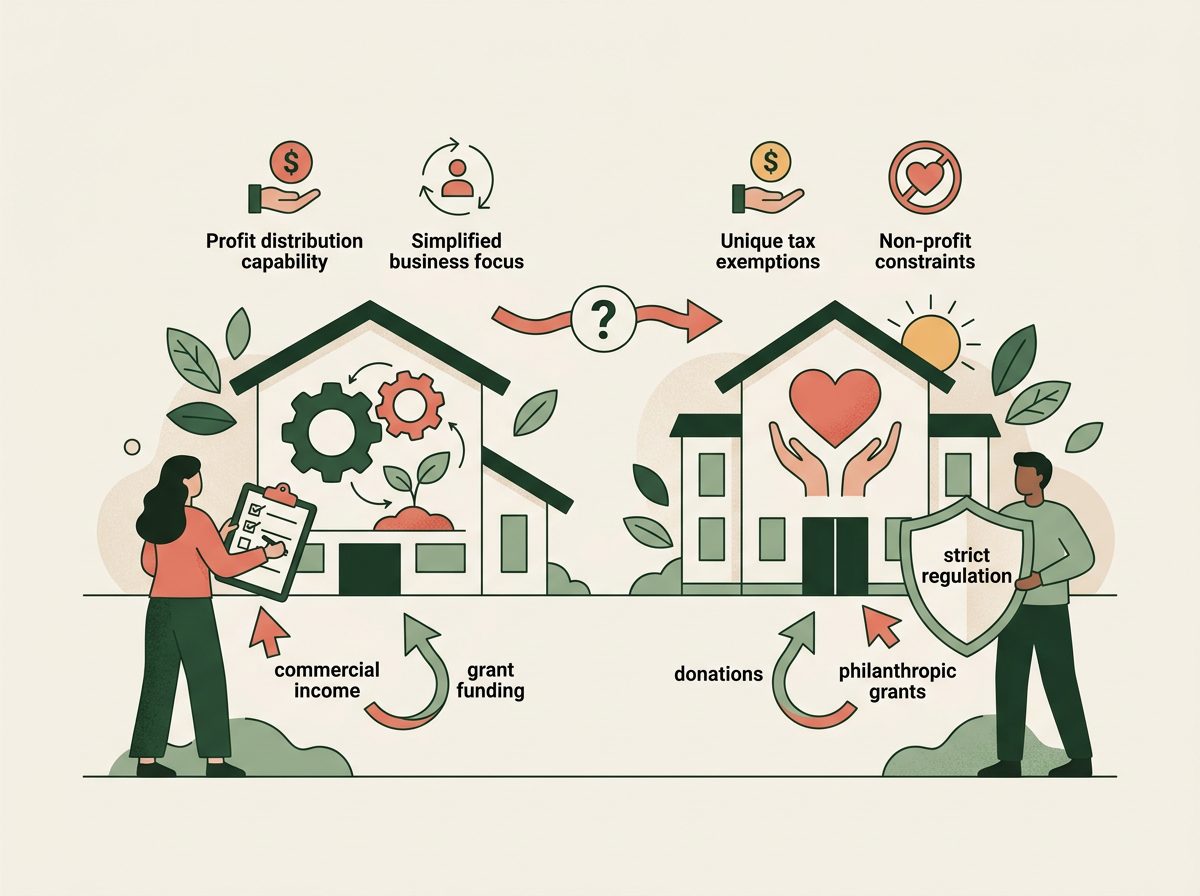
A Community Interest Company (CIC) is a special type of limited company that exists to benefit the community rather than private shareholders. Introduced in 2005, CICs were designed to be a straightforward legal structure for social enterprises looking to use their profits and assets for public good. They are regulated by the Regulator of Community Interest Companies, which ensures they meet the 'community interest test' and adhere to specific regulations, including an asset lock.
CICs are often chosen by organisations that have a strong trading element to their work, generating income through selling goods or services. This trading focus allows them to be more entrepreneurial and self-sustaining, reducing reliance on grants. While they can and do receive grants and donations, their primary financial model is typically rooted in earned income.
Choosing the right legal structure is one of the most important decisions for any social purpose organisation, influencing funding, governance, and long-term sustainability.
Key characteristics of a CIC:
- Community Interest Test: A CIC must satisfy the Regulator that a reasonable person would consider its activities to be carried on for the benefit of the community or a section of the community.
- Asset Lock: This legally binding provision ensures that all assets and profits are retained within the company and used for its social purpose. They cannot be distributed to members or directors, except in specific, limited circumstances (e.g., reasonable remuneration for services).
- Dividend Cap: If a CIC chooses to pay dividends (to attract social investment), there are strict limits on the amount that can be distributed to ensure the social mission remains paramount.
- Reporting Requirements: CICs must submit annual accounts to Companies House and an annual CIC report to the Regulator, detailing their activities and how they have met the community interest test.
Understanding Registered Charities
A registered charity in the UK is an organisation set up for charitable purposes only, which must provide public benefit. Charities are regulated by the Charity Commission (in England and Wales), OSCR (in Scotland), or CCNI (in Northern Ireland), depending on their location. To be registered, an organisation must demonstrate that its purposes fall within one of the 13 descriptions of charitable purposes specified in the Charities Act 2011 (or equivalent legislation in Scotland and Northern Ireland) and that it provides a clear public benefit.
Charities are often established to address specific social, environmental, or cultural issues through fundraising, advocacy, and direct service provision. Their primary source of income is typically voluntary donations, grants from trusts and foundations, and fundraising activities. While charities can and often do engage in trading activities, these must be secondary to their primary charitable purpose and comply with specific charity law rules regarding trading.
Key characteristics of a Charity:
- Charitable Purpose & Public Benefit: The core of a charity is its charitable purpose (e.g., relief of poverty, advancement of education, promotion of health) and its duty to demonstrate how it provides clear public benefit.
- Trustees: Charities are governed by trustees who are legally responsible for ensuring the charity operates according to its governing document and charity law. Trustees generally cannot be paid for their role, though expenses can be reimbursed and in some limited cases, trustees can be paid if clearly authorised and for public benefit.
- Tax Reliefs: Charities benefit from significant tax advantages, including exemption from Corporation Tax on most income and gains, Stamp Duty Land Tax relief, and eligibility for business rates relief. Donors can also make donations under Gift Aid, allowing the charity to reclaim basic rate tax on their donation.
- Strict Regulation: The Charity Commission exercises proactive oversight, ensuring charities comply with charity law, manage their finances responsibly, and operate for their stated charitable purposes.
The Great Divide: Funding Opportunities
One of the most significant factors influencing your choice of structure is access to funding. This is where the distinction between CICs and charities becomes particularly stark.
Charity Funding Access:
- Trust and Foundation Grants: Registered charities have privileged access to the vast majority of grant funding from charitable trusts and foundations. Many funders explicitly state that they only award grants to organisations with registered charitable status.
- Gift Aid: Registered charities can reclaim basic rate tax on eligible donations from UK taxpayers through the Gift Aid scheme, increasing the value of donations by 25%. This is a substantial benefit that CICs cannot access.
- Legacy Funding: Bequests and legacies often specify charities as beneficiaries, making this a significant funding stream for many established charities.
- Larger Corporate Social Responsibility (CSR) Programmes: While some companies support CICs, many larger CSR programmes are structured to support registered charities, often for tax-efficiency reasons or due to internal policies.
CIC Funding Access:
- Earned Income and Trading: CICs excel at generating income through selling goods and services. This self-sustaining model is often their primary funding source.
- Social Investment: CICs are well-positioned to attract social investment (loans, equity investment, bonds) from specialist social investors who are looking for a financial return alongside social impact. The ability to pay limited dividends can be attractive to some social investors.
- Specific Grant Programmes: There are some funders and government programmes specifically aimed at social enterprises and CICs, though these are generally fewer in number than those for charities. Growth fund programmes for social businesses are an example.
- Community Share Offers: CICs can raise capital through community share offers, allowing members of the community to invest in the enterprise and often receive a modest return.
Regulation and Governance Compared
The regulatory burden and governance requirements also differ considerably between the two structures.
Charity Regulation:
- Charity Commission (or equivalent): Charities are subject to oversight by the Charity Commission. This involves compliance with charity law, submitting annual returns and accounts, and adhering to strict rules on trustee duties, conflicts of interest, and managing assets.
- Public Scrutiny: As public benefit organisations, charities face a higher degree of public and media scrutiny regarding their operations, spending, and ethical conduct.
- Strict Governance: Trustees have significant fiduciary and legal duties, ensuring the charity acts solely in the public benefit and for its stated charitable purposes.
CIC Regulation:
- Regulator of Community Interest Companies: CICs are regulated by the CIC Regulator, which primarily ensures that the company satisfies the community interest test and complies with the asset lock and dividend cap.
- Companies House: Like all limited companies, CICs must comply with Companies House requirements, including filing annual accounts and confirmation statements.
- Lighter Touch: While there is oversight, the regulatory burden on CICs is generally considered lighter and more focused on their social mission and asset lock, rather than the broader public benefit test and governance scrutiny applied to charities.
| Feature | Community Interest Company (CIC) | Registered Charity |
|---|---|---|
| Primary Purpose | Trading for social benefit | Advancing charitable purposes for public benefit |
| Main Regulator | CIC Regulator & Companies House | Charity Commission (or OSCR/CCNI) |
| Funding Access | Trading income, social investment, some grants | Grants (trusts/foundations), donations (Gift Aid), legacies, fundraising events |
| Tax Reliefs | Limited (e.g., standard Corporation Tax reliefs) | Extensive (Corporation Tax exemptions, Gift Aid, business rates relief) |
| Governance | Company Directors (can be paid) | Trustees (generally unpaid volunteers) |
Tax Implications
The tax treatment of CICs and charities is another critical area of difference.
Charity Tax Benefits:
- Corporation Tax Exemption: Charitable income and gains used for charitable purposes are exempt from Corporation Tax. This includes income from donations, grants, trading profits (if primary purpose or small scale), investment income, and gains from selling assets.
- Gift Aid: As mentioned, charities can claim an extra 25p for every £1 donated by UK taxpayers.
- Business Rates Relief: Charities can claim 80% mandatory business rates relief on properties used for charitable purposes, with local authorities having discretion to top this up to 100%.
- Stamp Duty Land Tax (SDLT): Charities are exempt from paying SDLT on land and property acquisitions if used for charitable purposes.
- VAT: While not fully exempt, charities benefit from various VAT reliefs on certain purchases and services.
CIC Tax Position:
- Corporation Tax: CICs are subject to Corporation Tax on their profits, similar to any other limited company. There are no specific CIC tax exemptions.
- VAT: CICs are subject to VAT in the same way as other businesses, registering if their turnover exceeds the threshold.
- Business Rates: CICs do not automatically qualify for mandatory business rates relief, though local authorities may offer discretionary relief if they deem the CIC to be beneficial to the community.
It's clear that the financial benefits for charities are significantly more comprehensive, which can lead to substantial savings and increased fundraising potential.
Choosing the Right Path: Which is for you?
The decision between a CIC and a charity ultimately depends on your organisation's core mission, its intended activities, and its funding strategy.
Choose a CIC if:
- Your primary model is trading: You plan to generate most of your income by selling goods or services, with profits reinvested for community benefit.
- You value commercial flexibility: You want the ability to operate more like a business, make independent decisions quickly, and potentially attract social investment.
- You want a faster setup: Setting up a CIC is generally quicker and less complex than registering a charity.
- You prefer lighter regulation: You are comfortable with Companies House reporting and CIC Regulator oversight, but prefer less intense scrutiny than the Charity Commission.
- Your directors may be paid: You wish to pay directors for their services, which is more straightforward in a CIC.
Choose a Charity if:
- Your primary model is fundraising and grant-seeking: You intend to rely heavily on donations, grants from trusts and foundations, and public fundraising.
- You can meet the public benefit test: Your purposes align with the legal definition of charitable purposes and you can clearly demonstrate public benefit.
- You want access to Gift Aid and extensive tax reliefs: These financial benefits are a significant advantage for charities.
- You are comfortable with stricter regulation: You embrace the governance requirements and public accountability that come with Charity Commission oversight.
- Your trustees will be unpaid: You plan for a board of voluntary trustees who will oversee the charity's mission.
Can you switch between structures?
It is possible to convert a CIC to a charity or vice-versa, but it's not a trivial process and comes with its own complexities. For example, converting a CIC to a charity involves applying for charitable status, and all assets transferred must be used for charitable purposes. Similarly, converting a charity to a CIC would require careful consideration of existing charitable assets and the Charity Commission's permission, which is not easily granted if it means losing charitable tax benefits without strong justification.
It is far more efficient and less resource-intensive to choose the correct structure from the outset. Professional advice from a solicitor specialising in charity and company law is highly recommended before making a final decision.
Next steps
Once you are clear on your organisation's primary purpose and funding model, you can confidently choose the legal structure that best supports your mission. If you are still unsure, consider seeking expert legal advice specific to your circumstances. Understanding the implications of each choice will empower you to build a resilient and impactful organisation for the benefit of your community.