

Funding Readiness: Your Charity's Scorecard to Success
As a charity or social enterprise in the UK, securing funding is often a critical hurdle. Many funders, particularly trusts and foundations, receive hundreds of applications for every grant they make. How do they decide who to support? Beyond the strength of your project idea, they look closely at your organisation's overall health and capacity. This is where 'funding readiness' comes in. Understanding your funding readiness score isn't just about assessing where you stand; it's about gaining a clear roadmap to strengthen your organisation and significantly improve your chances of securing those vital grants.
Think of funding readiness as a holistic assessment of your charity’s foundational strength across key areas that funders scrutinise. It’s not just about having a compelling project; it’s about proving your ability to deliver that project effectively, responsibly, and sustainably. A robust funding readiness score reflects a well-run organisation, instilling confidence in potential funders that their investment will be well-managed and achieve tangible impact.
Key Takeaways
- A funding readiness score assesses your organisation's foundational strength across governance, finance, evidence, communications, and pipeline.
- A score of 70+ indicates readiness for most UK trust and foundation funders.
- Scores below 50 suggest prioritising organisational improvements before extensive grant applications.
- Improving your score means strengthening internal processes, data collection, and external communication.
What Does a Funding Readiness Score Measure?
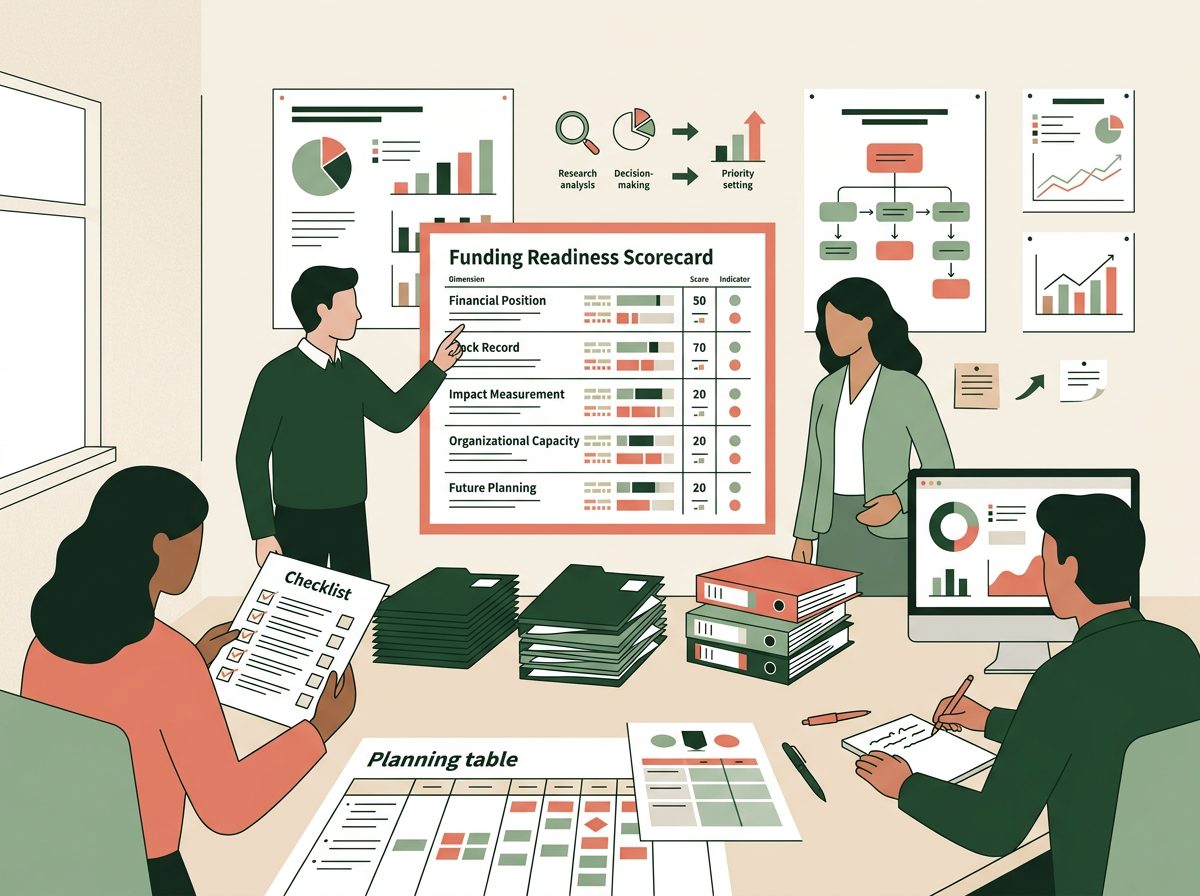
A comprehensive funding readiness score typically evaluates five crucial dimensions of your charity or social enterprise. Each dimension contributes to an overall picture of your organisational health and capacity. Funders use these indicators to manage their risk and ensure their grant-making is effective. Understanding what each dimension entails is the first step towards improvement.
- Governance and Leadership: This dimension assesses the effectiveness of your board of trustees or directors, your legal compliance, and your strategic direction. Funders want to know that your organisation is well-managed, legally sound, and has a clear vision for the future. Are your policies up-to-date? Is your board active and diverse? Do you have clear succession planning?
- Financial Management: Sound financial health is paramount. This goes beyond simply having money in the bank. It examines your budgeting process, reserves policy, financial reporting, and audit history. Funders need assurance that you can manage grants responsibly and that your organisation is financially stable. Do you have a clear plan for sustainability? Are your financial controls robust?
- Evidence and Impact: Funders want to see that your work makes a difference. This dimension evaluates your ability to track, measure, and report on the impact of your activities. It looks at your monitoring and evaluation frameworks, data collection methods, and how you use evidence to inform your work and demonstrate success. Can you clearly articulate the problem you solve and the change you create?
- Communications and Engagement: How effectively do you tell your story and engage with stakeholders? This dimension covers your external communications, including your website, social media presence, annual reports, and how you communicate your impact to diverse audiences. Funders look for clarity, professionalism, and a consistent message. Does your brand inspire confidence and resonate with your target audience?
- Funding Pipeline and Strategy: This assesses your approach to fundraising more broadly. Do you have a diverse income stream? Is there a clear strategy for securing future funding beyond a single grant? Funders prefer organisations that aren't solely reliant on one source of income and demonstrate a proactive approach to long-term financial sustainability. Do you know who your potential funders are and how you will approach them?
Interpreting Your Score: What Does "Good" Look Like?
A funding readiness score is typically expressed as a percentage or a score out of 100. While some variation exists, a general guideline helps interpret your organisation's position:
Below 50: Remedial Foundations Needed
A score in this range indicates significant foundational weaknesses across multiple dimensions. Applying for competitive grants at this stage is likely to be challenging and may lead to repeated rejections. Your primary focus should be on internal strengthening. Prioritise addressing the most critical gaps in governance, financial controls, and basic impact measurement. Engaging with local infrastructure organisations or seeking pro-bono support can be incredibly helpful here.
50-69: Developing, but Room for Growth
Organisations in this range have some core strengths but also identifiable areas for improvement. You may be successful with smaller, less competitive grants, or with funders who focus on capacity building. The key here is strategic improvement. Identify the one or two dimensions where your score is weakest and invest time and resources into strengthening them. Perhaps your impact measurement needs more rigour, or your communications lack consistency. This is a solid starting point for focused development.
70-84: Fundable and Competitive
Congratulations! A score in this range indicates that your organisation is generally well-prepared and presents a strong case to most UK trust and foundation funders. You demonstrate sound governance, responsible financial management, and a clear understanding of your impact. Funders will view your applications positively, focusing more on the quality of your project and its alignment with their priorities. Continuous improvement is still important, but your immediate focus can be on strategic grant applications.
85-100: Exemplary and Highly Desirable
This is the pinnacle of funding readiness. Organisations achieving this score are exemplary across all dimensions. They demonstrate best-in-class governance, robust financial health, sophisticated impact measurement, compelling communications, and a well-articulated funding strategy. Funders will actively seek out partnerships with organisations at this level, viewing them as highly reliable and impactful. Maintaining this level requires ongoing vigilance and adaptation.
Prioritising Improvements to Boost Your Score
Once you have a score, the natural next question is: what next? The power of the scorecard lies in its ability to highlight specific areas for improvement. Rather than feeling overwhelmed, focus on a strategic approach.
| Score Range | Primary Focus | Example Actions |
|---|---|---|
| Below 50 | Building fundamentals | Formalise board meetings, implement basic financial controls, articulate mission, track attendance. |
| 50-69 | Targeted strengthening | Develop a reserves policy, refine M&E framework, update website, create a fundraising plan. |
| 70-84 | Strategic enhancement | Broaden board diversity, diversify income streams, invest in professional communications, refine impact reporting. |
| 85-100 | Innovation & leadership | Pilot new service models, thought leadership, mentor smaller organisations, advocate for sector change. |
Start with Your Weakest Link: It's tempting to work on what feels easiest, but often the greatest gains come from addressing your most significant weaknesses. If your governance score is particularly low, dedicating time to recruiting new trustees or updating your core policies will yield a higher return on investment than finessing an already strong communications strategy.
Seek External Input: Sometimes, an outside perspective is invaluable. Engage with a sector consultant, an experienced trustee, or even a volunteer with relevant business skills to review specific dimensions of your organisation. They can often identify blind spots or suggest practical solutions you might not have considered.
Leverage Resources: Many infrastructure bodies, such as the National Council for Voluntary Organisations (NCVO), Small Charities Coalition, and local CVS organisations, offer free or low-cost resources, templates, and training to help charities strengthen their internal operations. Don't feel you have to reinvent the wheel.
"Funders don't just invest in projects; they invest in organisations. A high funding readiness score signals a reliable partner capable of delivering real change and managing funds responsibly. It's about trust over transactional grant-making." - Serin Editorial Team
The Strategic Benefits of a High Score
Achieving a high funding readiness score offers far more than just better chances of securing grants. It underpins the overall health and sustainability of your charity. Internally, a strong score reflects efficient processes, clear roles, and effective leadership. This leads to better staff morale, reduced operational risks, and a stronger reputation within the sector.
Externally, a high score positions you as a credible and attractive partner, not just for funders, but also for collaborators, volunteers, and even beneficiaries. It demonstrates accountability and professionalism, solidifying your standing within your community and beyond. It can also open doors to larger, multi-year funding opportunities, allowing for more strategic and long-term planning rather than constant crisis fundraising.
Consider the long-term strategic advantage: organisations with strong foundations can adapt more quickly to changing circumstances, innovate more effectively, and ultimately achieve greater impact. This resilience is invaluable in today's dynamic funding landscape.
Next Steps
Understanding your funding readiness is an ongoing journey, not a one-off assessment. Use the insights from your scorecard to develop an action plan. Break down large improvements into smaller, manageable steps. Regularly review your progress and consider re-evaluating your score annually or biannually. By committing to continuous improvement in these key areas, your charity will not only become more attractive to funders but also significantly more effective in delivering its crucial mission.