
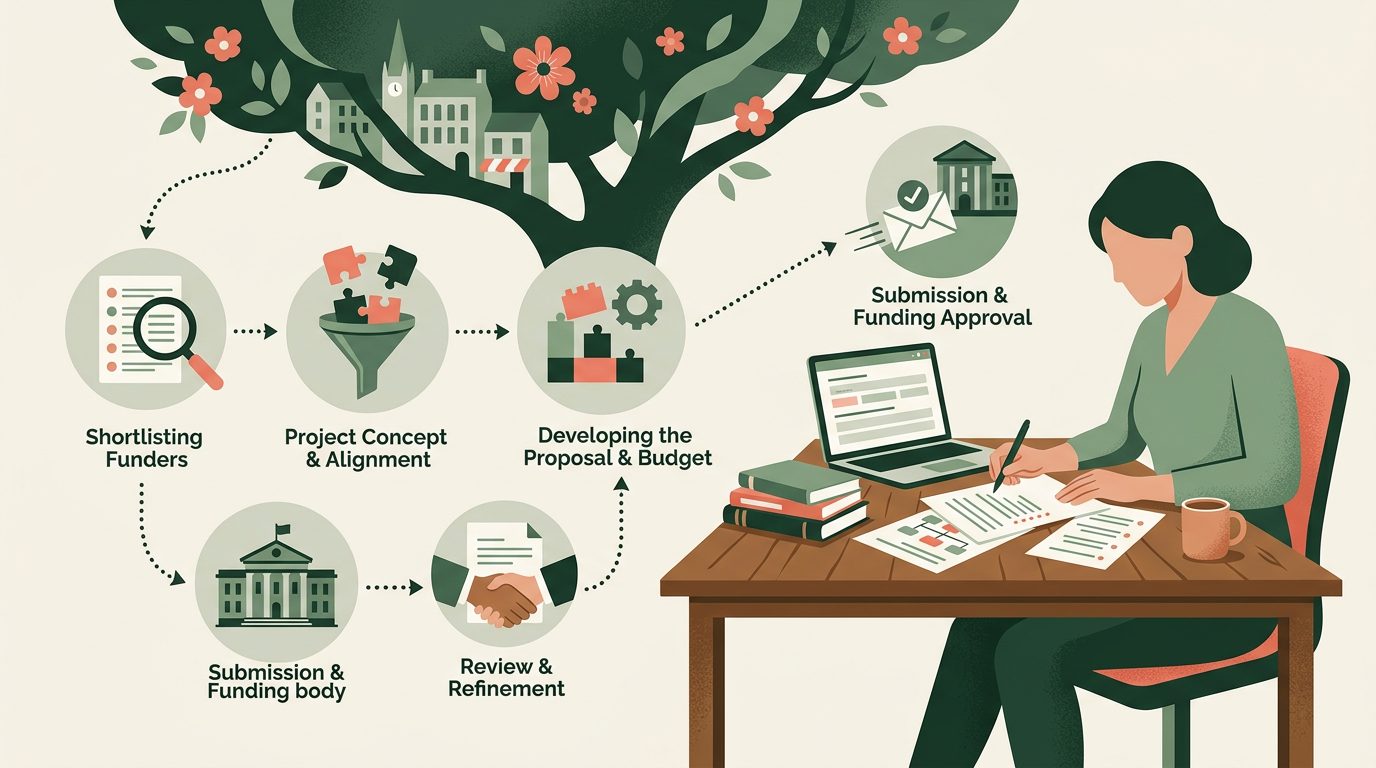
Harnessing the Power of Grant Funding: Your Guide to Successful Applications
For many UK charities and Community Interest Companies (CICs), grant funding is the lifeblood that enables them to deliver vital services, innovate, and expand their impact. However, the grant application process can often feel daunting, a labyrinth of requirements and detailed questions. This comprehensive guide will demystify the process, providing a clear, repeatable framework to help your organisation write grant applications that stand out and secure the funding you need.
We’ll walk through the entire journey, from identifying suitable funders to submitting a polished proposal, ensuring you understand the core principles that underpin successful grant writing. Our aim is to equip you with the knowledge and confidence to approach grant applications strategically, transforming what can be a struggle into a streamlined, effective process.
Key Takeaways:
- Match funder priorities precisely before applying.
- Provide strong, local evidence of the need your project addresses.
- Clearly define measurable outcomes and how they will be tracked.
- Develop an honest, detailed, and justifiable project budget.
- Answer every question asked, directly and concisely.
Before You Write a Single Word: Strategic Preparation
Before diving into the narrative, strategic preparation is paramount. This initial phase sets the stage for everything that follows and is often where many organisations unwittingly falter. It's about understanding the funding landscape, your own organisation's needs, and critically, the expectations of potential funders.
The first step is to thoroughly understand your organisation's current position and funding needs. What specific project or core area requires funding? What gap will this funding fill? Be clear about your objectives and how they align with your charity's wider mission. This internal clarity will serve as your compass throughout the application process.
"Effective grant writing isn't just about selling your project; it's about deeply understanding the funder's mission and demonstrating how your work perfectly aligns with their goals. It's a partnership from the very first word."
Equally important is a detailed understanding of your target beneficiaries and the specific problems you aim to solve for them. Funders are looking for impact, and impact is built on addressing genuine, evidenced needs. This preparatory work will form crucial sections of your application, so invest time here.
Finding the Right Funder: It's All About Fit
Applying to every funder you come across is a common mistake and a significant waste of precious resources. The most effective approach is to identify funders whose priorities, geographical focus, and funding size align perfectly with your project and organisation. This isn't just about checking boxes; it's about finding a genuine philosophical alignment.
Start by researching potential funders thoroughly. Look beyond their general mission statement. Delve into their past grants awarded, their specific funding programmes, and any particular areas of interest they highlight. Many funders provide detailed guidelines and criteria; these are your roadmap. Pay close attention to what they explicitly state they will and will not fund. Understanding a funder's motivations and strategic objectives is key to tailoring your application effectively. Remember, they have their own charitable objectives to meet, and your project needs to help them achieve theirs.

Crafting Your Narrative: Telling Your Story with Impact
Once you've identified a suitable funder, the real writing begins. Your application needs to tell a compelling story, one that persuades the funder that your project is not only worthy but essential. This story should be built on a foundation of evidence, clarity, and passion.
Begin by clearly articulating the problem your project addresses. This isn't just about stating a general issue; it's about providing specific, local evidence of need. Use statistics, case studies, and anecdotal evidence to paint a vivid picture of the challenge. For example, rather than saying 'there is homelessness in our town,' you might state, 'local authority data shows a 15% increase in rough sleepers in [town] over the last year, with specific challenges for young people aged 18-25 lacking family support, as highlighted by our recent outreach survey.' This brings the problem to life and demonstrates your local insight.
Next, introduce your proposed solution. This is where you explain what your project will do, who it will help, and how it will achieve its objectives. Be detailed and pragmatic. Avoid jargon and abstract concepts. Explain the 'how' as much as the 'what'. Funders want to understand the mechanics of your intervention and be confident in your charity's ability to deliver it.
Defining Measurable Outcomes, Not Just Activities
A critical component of any strong grant application is a clear outline of your project's outcomes. Outcomes are the changes, benefits, learning, or other effects that happen as a result of your project activities. They are the 'so what?' of your work. Funders are increasingly focused on impact and will want to see how you measure success.
Activities are what you do (e.g., 'we will run ten weekly workshops'). Outcomes are what happens as a result (e.g., 'participants will report increased confidence in managing their mental health'). For each outcome, define clear, measurable indicators. How will you know if you've achieved your outcome? What data will you collect? This allows you and the funder to track progress and evaluate the project's success. Avoid vague statements. Instead of 'we will raise awareness,' try '80% of workshop participants will demonstrate an improved understanding of healthy eating practices, as measured by pre and post-workshop questionnaires.'
Budgeting for Success: Honesty and Detail
Your project budget is more than just a list of costs; it's a financial reflection of your project plan. A well-constructed budget demonstrates your financial acumen, realism, and respect for the funder's money. It should be comprehensive, detailed, and directly align with the activities described in your application.
Every line item in your budget should be justified and clearly explained. Think about all potential costs: staff salaries (including on-costs like National Insurance and pension contributions), project materials, venue hire, transportation, evaluation costs, and a reasonable allocation for overheads (often referred to as 'full cost recovery'). Be honest about the true cost of delivering your project. Undercosting can lead to project shortfalls, while overcosting can signal a lack of financial control.
Explain how you arrived at estimated costs. For example, if you're requesting funds for staff time, specify the role, percentage of time allocated to the project, and the hourly or annual rate. If you have secured match funding from other sources, clearly state this, as it demonstrates broader support for your project and can increase your attractiveness to funders. Many funders will also ask how you plan to sustain the project beyond their funding period, so having a thought-out sustainability plan is crucial.
| Budget Category | Item Details | Estimated Cost (£) | Justification |
|---|---|---|---|
| Staff Salaries | 0.5 FTE Project Coordinator (3 months) | 7,500 | Oversees project delivery, participant liaison, data collection. |
| Project Materials | Workshop supplies (art materials, hand-outs) | 1,200 | Essential for successful delivery of 12 weekly workshops. |
| Venue Hire | Community Hall (12 sessions x £50/session) | 600 | Safe and accessible space for all project activities. |
| Monitoring & Evaluation | External Evaluator (2 days @ £400/day) | 800 | Ensures robust, independent assessment of outcomes. |
| Overheads | 10% of direct costs (office, utilities, admin) | 1,010 | Contributes to charity's essential core operating costs. |
Answering the Question Asked, and Then Some
This might seem obvious, but it's astonishing how often applicants miss this fundamental requirement. Funders ask specific questions for a reason, and they expect direct, comprehensive answers. Read each question carefully, multiple times if necessary, to ensure you fully understand what is being asked.
If a question asks for 'the difference your project will make to beneficiaries,' don't just describe your activities; explain the impact and change. If it asks for 'how you will measure success,' provide concrete indicators and methods. Avoid copying and pasting generic paragraphs from previous applications without tailoring them to the specific question and funder. Each application is a unique conversation.
Beyond directly answering the question, consider what implicit information the funder might be seeking. Sometimes a question about 'risk' also implies a desire to understand your organisation's capacity for mitigation. A question about 'sustainability' also implies a desire to see your long-term vision. Use the opportunity to showcase your organisation's strengths, experience, and commitment, always linking back to the funder's priorities.
The Final Review: Polishing for Perfection
Before hitting 'submit', a thorough review process is non-negotiable. This isn't just about spell-checking; it's about ensuring clarity, coherence, and impact. A fresh pair of eyes can catch errors or unclear passages that you, as the author, might overlook.
Your Final Application Checklist:
- Is every question answered fully and directly?
- Does the project align with the funder's priorities?
- Is the evidence of need compelling and relevant?
- Are the outcomes clear, measurable, and realistic?
- Is the budget detailed, justified, and accurate?
- Is the language clear, concise, and free of jargon?
- Are there any grammatical errors or typos?
- Have all required attachments been included and correctly labelled?
- Has someone else reviewed the entire application for clarity and impact?
- Have you allowed ample time for online submission troubleshooting?
A well-written, well-structured, and error-free application reflects positively on your organisation's professionalism and attention to detail. It shows respect for the funder's time and confidence in your ability to manage a project effectively.
Next Steps
Mastering grant writing is an ongoing process of learning, refining, and adapting. Each application provides valuable experience. Even if unsuccessful, use the feedback (if provided) to improve your next submission. By adopting a methodical approach, focusing on alignment, evidence, and clear communication, your UK charity can significantly increase its chances of securing the vital funding it needs to make a difference.