
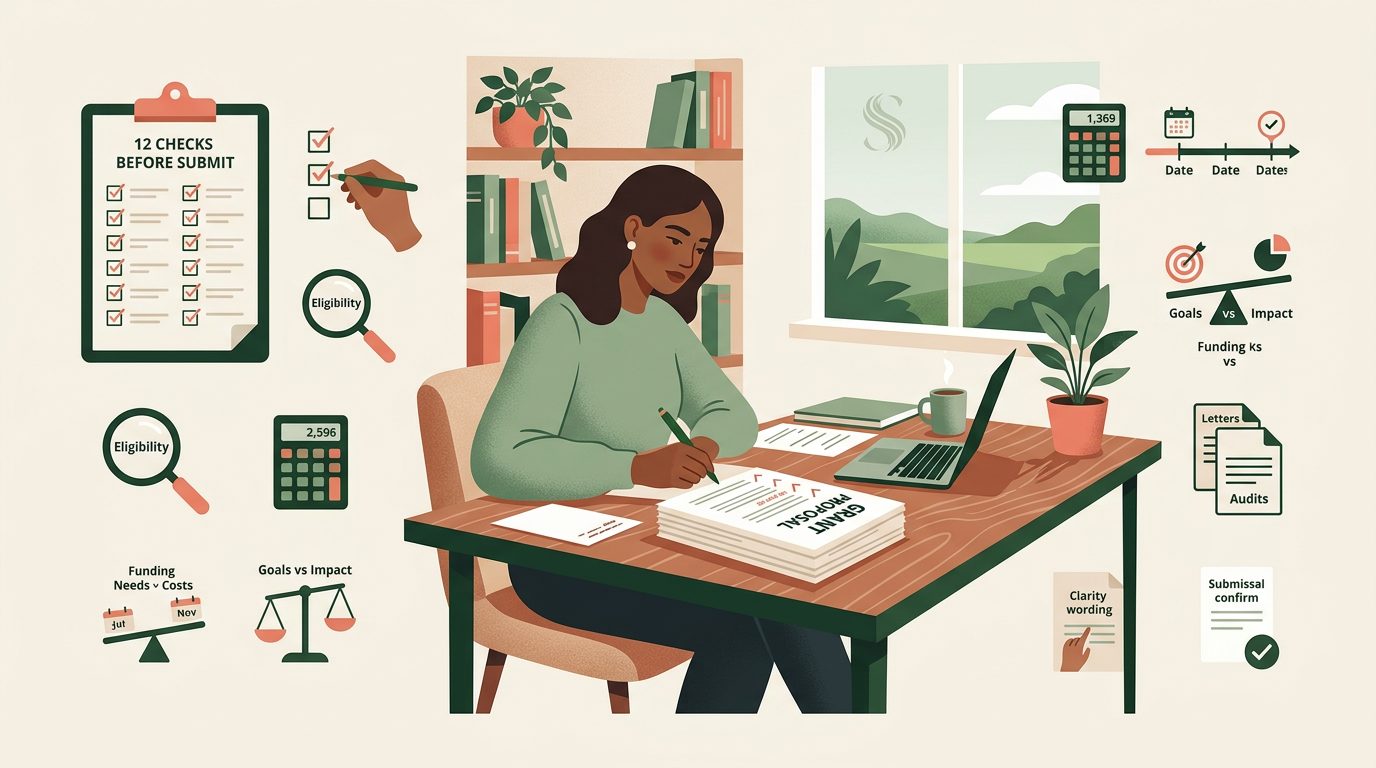
The Grant Application Editing Checklist: Your Final 12 Checks Before Submission
Writing a compelling grant application takes time, effort, and a deep understanding of your work. But the writing is only half the battle. Many charities, large and small, fall at the final hurdle: the editing and proofreading stage. Skipping this crucial phase can mean the difference between securing vital funding and receiving a polite rejection letter.
At Serin, we've seen countless applications that were strong in content but tripped up on avoidable errors. This guide outlines a comprehensive 12-point checklist designed to catch the most common reasons small charities and CICs lose out on grant applications. Think of it as your essential pre-flight check before submitting your hard-earned work.
Key Takeaways:
- Editing is as crucial as writing for securing grants.
- Avoidable errors are common but easily fixed with a structured check.
- A fresh pair of eyes can spot issues you've missed.
- Each check on this list addresses a frequent reason for rejection.
Why Editing is Non-Negotiable for Grant Success
It's tempting to hit 'submit' the moment you've finished typing the last word. You've poured your heart and soul into describing your project, your beneficiaries, and the impact you hope to achieve. However, a grant application isn't just about the words; it's also about accuracy, clarity, and demonstrating professionalism. Funders are often sifting through hundreds of applications, and any sign of haste, error, or misunderstanding can inadvertently signal a lack of attention to detail, which might reflect on how your project would be managed.
Meticulous editing demonstrates respect for the funder's time and resources. It shows that you care enough to present your best work. More practically, it ensures that your brilliant ideas are communicated effectively, your budget figures add up, and you've met all the funder's specific requirements. Overlooking these seemingly small details can lead to your application being dismissed, not because your project isn't worthy, but because its presentation undermined its potential.

The 12-Point Grant Application Editing Checklist
Let's dive into the practical steps. Before you ever click 'submit', run through each of these checks. It might feel like a minor delay, but it could be the most valuable time you spend on your application.
-
Eligibility Check: Have You Ticked All the Boxes?
This is the most fundamental step. Go back to the funder's guidelines. Have you met every single one? Are you registered in the correct legal form (e.g., charity, CIC)? Is your annual income within their specified range? Does your project align perfectly with their stated priorities? Missing an eligibility criterion is an instant rejection, no matter how good the rest of your application is. Make sure you haven't just skimmed the criteria; read them thoroughly and cross-reference against your application.
-
Word and Character Counts: Staying Within Limits
Funders often provide strict word or character limits for a reason: they need concise, impactful information. Exceeding these limits can show a lack of discipline or an inability to summarise effectively. Conversely, sometimes writing too little suggests you haven't fully thought through your answer. Check every single text box. If you're slightly under, consider if you can add more impactful details. If you're over, ruthless editing is required to distill your message without losing essential information. This isn't just about fitting; it's about making every word count.
-
Question Match: Are You Answering What They're Asking?
It sounds obvious, but in the desire to tell your story, it's easy to answer the question you wish they had asked, rather than the one they actually did. Read each question aloud. Then read your answer aloud. Does your answer directly and wholly address the question? Or have you veered off course? Often, applicants explain their project's 'what' beautifully, but neglect the 'why' or 'how' if the question specifically asks for those elements. Customise each answer; don't just copy and paste from a generic template.
-
Outcomes and Impact: Clear, Measurable, and Realistic
Funders want to know what difference their money will make. Are your outcomes SMART (Specific, Measurable, Achievable, Relevant, Time-bound)? Have you clearly differentiated between outputs (e.g., 20 workshops delivered) and outcomes (e.g., 100 people gaining new skills)? And crucially, is your proposed impact realistic given the funding requested and timescale? Avoid vague statements like 'we will help people'. Instead, focus on '10 young people will achieve a qualification,' or '50 adults will report improved mental wellbeing as measured by…'.
-
Budget Totals and Narrative: Accuracy is Paramount
This is where many applications stumble. Does your budget section's total match the total you've requested? Do all the line items make sense? Is your budget narrative clear about what each cost covers? Are ineligible costs included? Double-check all arithmetic. A discrepancy here immediately raises a red flag about your organisation's financial management capabilities. Round numbers can be helpful but ensure they are justifiable. If you're asking for project-specific staffing, clearly outline their role and the proportion of their salary requested.
"A budget is more than just numbers; it's a narrative that shows how you plan to spend the funder's money wisely. Any error casts doubt on your entire proposal."
- Serin Grants Advisor -
Evidence and Data: Supporting Your Claims
Are your statements backed up by evidence? When you say there's a 'huge local need', have you cited statistics, reports, or testimonials? When you claim your project is 'effective', have you included past evaluation results or case studies? Funders are rarely swayed by anecdotal evidence alone. Provide data that demonstrates the problem you're addressing is real and that your solution has a strong likelihood of success.
-
Tone and Voice: Professional, Passionate, and Positive
Is your application professional yet engaging? Avoid overly formal jargon, but also steer clear of being too informal. Does it convey your passion for the cause and your beneficiaries? Is the tone positive and forward-looking, even when describing challenging issues? Funders respond well to applications that balance professionalism with genuine commitment. Ensure consistency in tone throughout the document.
-
Jargon and Acronyms: Keep it Clear for Everyone
While you might be steeped in sector-specific language, the person reading your application might not be. Assume they know nothing about your particular field or your organisation's internal acronyms. Spell out acronyms on first use, and replace any technical jargon with plain English. If a term is essential and specialist, explain it simply. Clarity is king; you don't want the funder to spend time decoding your application.
-
Repetition: Streamline Your Message
Have you repeated the same information or phrases in multiple sections? While some overlap is inevitable (e.g., project name), unnecessary repetition wastes valuable word count and can make your application tedious to read. Try to refer back to previous answers where appropriate, rather than re-stating entire sections. Each part of the application should build on the last, adding new information or elaborating on a different aspect.
-
The Story: Is it Compelling and Coherent?
Beyond the individual answers, does your application tell a coherent and compelling story? Can the reader follow your logic from the identified need, through your proposed activities, to the desired impact? Does it paint a clear picture of who you are, what you do, and why it matters? Imagine yourself as someone completely unfamiliar with your organisation; do they understand your journey and vision?
-
The Ask: Is it Clear and Justified?
Is it crystal clear exactly what you are asking for, and why? Does the amount requested directly relate to the activities and outcomes described? There should be no ambiguity about how the funds will be used and what contribution they will make. Ensure your 'ask' feels proportionate to your project's scope and the funder's typical grant size.
-
A Fresh Reader: The Ultimate Test
After you've done everything else, get someone else to read your application. Ideally, this should be someone who isn't intimately familiar with your project – perhaps a trustee, a volunteer, or even a friend from outside the charity sector. Ask them: 'Is anything unclear? Have I answered all the questions? Are there any typos or grammatical errors?' A fresh pair of eyes will spot errors and ambiguities you've become blind to.
Common Pitfalls and How to Avoid Them
Beyond the checklist, a few recurring issues plague grant applications. Being aware of these can further refine your process.
| Mistake | How to Avoid |
|---|---|
| Late submission | Start early, use a project plan, set internal deadlines ahead of the funder's. |
| Using generic templates without customisation | Always tailor your application to the specific funder's priorities and questions. |
| Ignoring attachments | Carefully check required documents; ensure names and formats are correct. |
| Poor online portal navigation | Familiarise yourself with the online system ahead of time, save drafts frequently. |
| Lack of internal sign-off | Ensure trustees or senior management approve the final draft and budget for accuracy. |
The Benefit of a Rigorous Editing Process
Implementing a rigorous editing checklist might seem like extra work, but it's an investment that pays dividends. It significantly increases your chances of success, builds your organisation's reputation for professionalism, and ensures that your valuable time spent writing isn't wasted. A well-presented, error-free application gives funders confidence in your ability to deliver your project effectively and manage their funds responsibly.
Next Steps
Integrate this 12-point checklist into your grant writing process. Don't leave it to the last minute; allocate dedicated time for editing, proofreading, and seeking feedback. By applying these checks consistently, you'll not only submit stronger applications but also develop a more disciplined and effective approach to securing the funding your charity or CIC needs to thrive. Good luck with your next application!