
Introduction: Navigating the AI Frontier in Funder Research
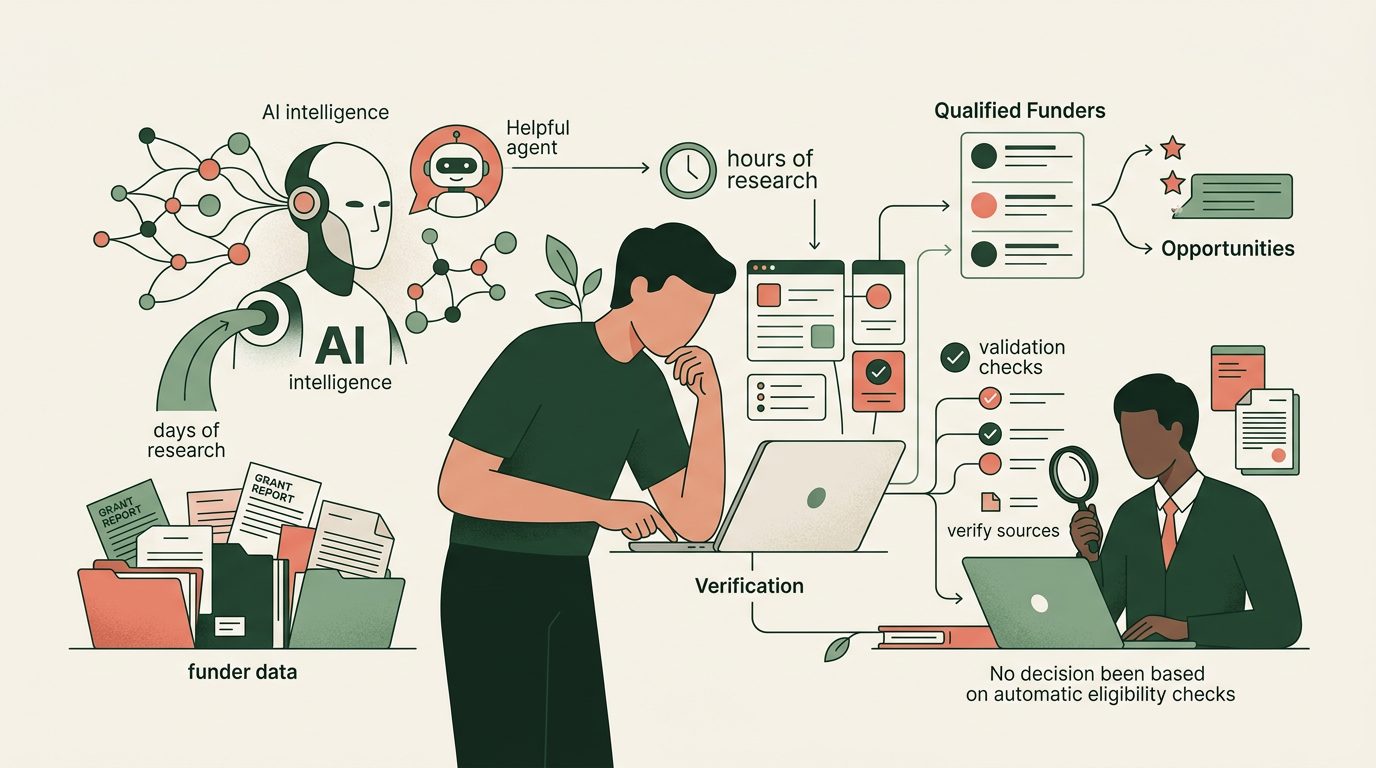
For UK charities and Community Interest Companies (CICs), securing funding is often a marathon, not a sprint. Every application requires meticulous research to identify funders whose priorities align perfectly with your mission. Traditionally, this process could take days, poring over databases, annual reports, and funder websites. The advent of Artificial Intelligence (AI) has dramatically reshaped this landscape, promising to compress hours into minutes and days into hours. However, this power comes with a crucial caveat: responsible use.
AI is a phenomenal research accelerator, an invaluable tool for shortlisting, summarising, and drawing comparisons between potential funders. But it is not, and should never be considered, a sole source of truth. Its outputs are only as reliable as the data it was trained on and its ability to interpret your queries. This article will guide you through leveraging AI effectively and ethically for funder research, ensuring you harness its power without falling prey to its pitfalls.
- Key takeaways:
- AI speeds up funder research but requires human verification.
- Always check eligibility criteria directly on funder websites.
- Use AI to summarise, compare, and brainstorm, not to make final decisions.
- Protect sensitive data; don't input confidential information into public AI tools.
- Develop a clear AI strategy tailored to your charity's needs.
The Power of AI: Shortlisting and Summarising
One of AI's most immediate benefits is its ability to rapidly sift through vast amounts of information. Imagine having a digital assistant that can read hundreds of funder profiles and pull out common themes or specific criteria. This capability is transformative for the initial stages of funder research. Instead of manually scanning dozens of charity commission entries or grant directories, AI tools can help you generate a preliminary list of potential funders based on keywords, project types, or beneficiary groups.
Once you have a list, AI can then summarise key aspects of each funder. Ask it to extract their mission statement, typical grant size, geographical focus, or preferred types of projects. This summarisation isn't meant to be your definitive guide but rather an efficient way to get a snapshot and determine if further, deeper investigation is warranted. It helps you quickly identify funders that are clearly not a fit, allowing you to focus your precious time on those with genuine potential.
"AI is brilliant for exploration and pattern recognition. It can highlight funders you might never have found through traditional searches, or connect dots you hadn't considered. But it's a co-pilot, not the pilot, in your funding journey."
Comparing Funders and Identifying Trends
Beyond individual summaries, AI excels at comparative analysis. If you have a shortlist of several promising funders, you can ask an AI to compare their grant-making priorities, application timelines, or even their approach to impact measurement. This can reveal subtle differences or strong alignments that might not be immediately obvious when looking at each funder in isolation. This insight can be invaluable for tailoring your approach and understanding where your charity might stand out.
Furthermore, AI can help you spot funding trends or emerging priorities within the philanthropic sector. By analysing public data from multiple funders over time, AI might identify a growing interest in environmental projects, digital inclusion, or specific types of mental health support. Understanding these broader trends can inform not only your current grant applications but also your long-term fundraising strategy and even your charitable programming.

The Non-Negotiable Step: Human Verification and Eligibility
This is the most critical message: AI is a research accelerator, not a source of truth for eligibility. You must verify every single piece of information, particularly eligibility criteria, directly on the funder's official website or through their official guidance documents. AI models can hallucinate, misinterpret, or provide outdated information. Funder criteria change, sometimes frequently, and an AI's knowledge cut-off might mean it's unaware of recent updates.
Relying solely on AI for eligibility could lead to wasted time writing applications for programmes you cannot apply to, or worse, submitting applications that are immediately rejected. Think of AI as a skilled researcher who gives you leads; it's your job to follow those leads to their primary source and confirm their validity. This human layer of verification is what transforms AI-assisted research into responsible and effective fundraising.
Ethical Considerations and Data Privacy
When incorporating AI into your charity's workflow, ethical considerations and data privacy are paramount. Most public AI tools learn from the data they process. This means that if you input sensitive or confidential information about your beneficiaries, programmes, or funding needs, it could potentially become part of the AI's training data, inadvertently exposing private details. Always use public AI tools with caution, and avoid entering any data that could compromise your charity or its service users.
If you're using internal or licensed AI tools, ensure you understand their data privacy policies and how they handle your input. Consider developing an internal policy for AI use, outlining what kind of information can and cannot be inputted, and who is responsible for verifying outputs. Transparency and accountability are key to responsible AI adoption within the charity sector.
Developing Your AI Strategy for Funder Research
Integrating AI effectively requires a strategy tailored to your charity's needs and capacity. Start small, perhaps by experimenting with free AI tools to summarise public funder information. Gradually, as you become more comfortable, you can explore more sophisticated applications. Here’s a basic framework for developing your strategy:
- Define Your Goals: What specific aspects of funder research do you want AI to assist with? (e.g., initial shortlisting, drafting project summaries, identifying trends).
- Choose Your Tools: Research and select AI tools that align with your budget, technical understanding, and data privacy requirements. Free tools like ChatGPT (with careful input) or Google Gemini can be a starting point.
- Establish Protocols: Create clear guidelines for how staff should use AI, including rules for data input, output verification, and attribution.
- Train Your Team: Provide basic training on how to prompt AI effectively and critically evaluate its outputs. Emphasise the importance of human verification.
- Review and Adapt: Regularly assess the effectiveness of your AI strategy. What’s working well? Where are the bottlenecks or risks? Adapt your approach as AI technology evolves and your charity's needs change.
Next Steps
Embracing AI in funder research is not about replacing human ingenuity but augmenting it. By using AI responsibly, with a robust verification process and an awareness of its limitations, UK charities and CICs can significantly streamline their funding efforts, freeing up valuable time to focus on what truly matters: delivering impactful services to their communities. Start experimenting, verify everything, and build your charity's AI literacy one step at a time.