
Navigating the AI landscape for UK charity grant writing
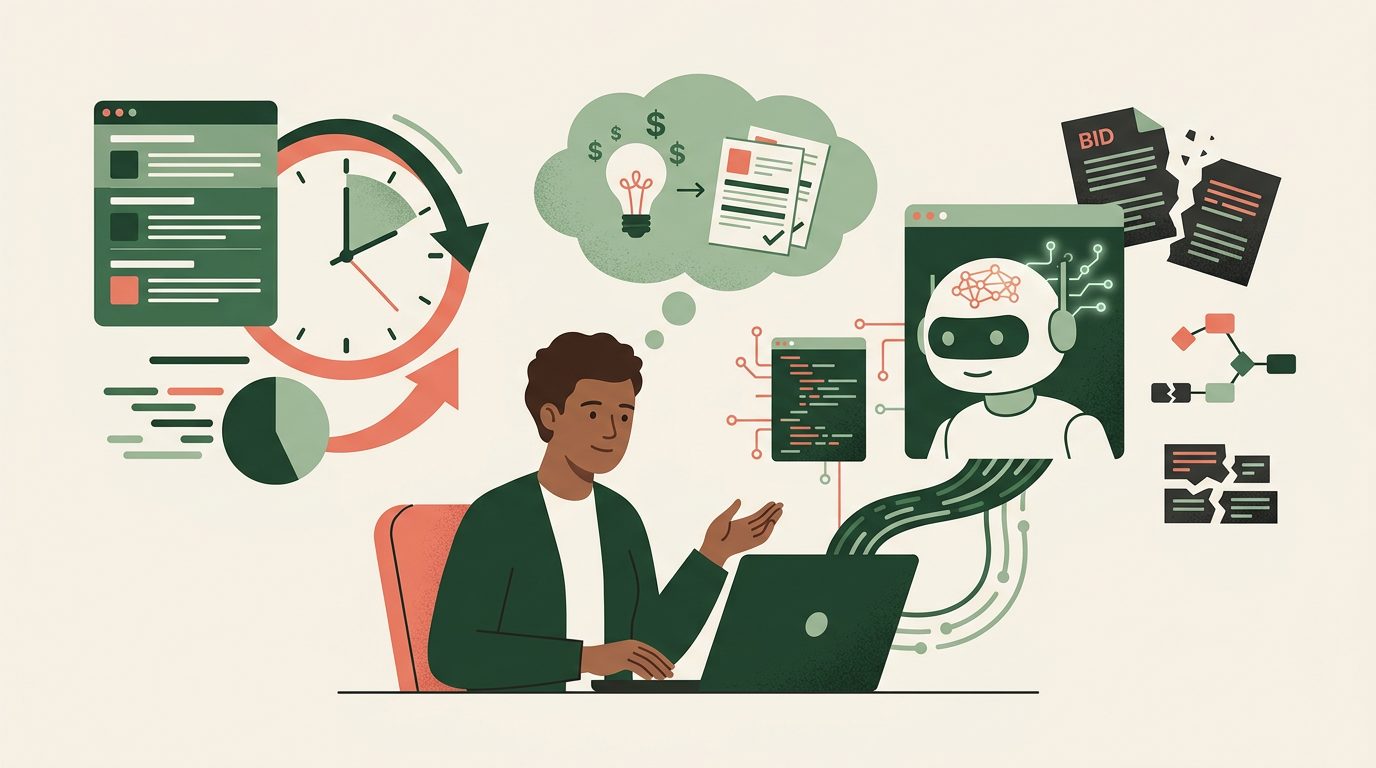
The dawn of artificial intelligence (AI) has brought with it a whirlwind of possibilities, and the charity sector is no exception. For UK charities and Community Interest Companies (CICs), the promise of AI to streamline grant writing can be incredibly appealing. Grant applications are time-consuming, resource-intensive, and often fraught with tight deadlines. It's natural to wonder if AI can provide a much-needed helping hand.
At Serin, we believe in embracing tools that genuinely empower charities. However, an honest, pragmatic approach to AI in grant writing is crucial. While AI offers remarkable capabilities for certain tasks, it also carries significant risks if misused. This article cuts through the hype to show you exactly where AI can add hours back into your week and, crucially, where it could silently damage your bids if left unchecked. Our aim is to help you leverage AI intelligently, ensuring your applications remain authentic, impactful, and ultimately successful.
Key takeaways:
- Use AI for research, structuring, and plain-English rewriting.
- Never use AI for beneficiary voice, funder-specific facts, or final polish.
- Always conduct a human review before submission.
- AI is a tool, not a replacement for human insight and empathy in grant writing.
- Prioritise ethical data use and confidentiality when using AI tools.
Where AI truly shines in grant writing
Let's start with the good news. There are several areas where AI can be an invaluable asset, transforming tedious tasks into efficient processes. When used strategically, AI can augment your capacity, allowing your team to focus on the higher-value, more human-centric aspects of grant writing.
1. Initial research and information gathering
Searching for relevant statistics, identifying community needs, or understanding the landscape of a particular social issue can be incredibly time-consuming. AI-powered tools can rapidly trawl through vast amounts of data, summarising key findings and highlighting trends. This doesn't replace in-depth qualitative research, but it can provide a strong foundation.
- Quickly find data on local demographics or need.
- Summarise academic papers or reports relevant to your cause.
- Identify common buzzwords or themes in successful proposals for similar projects.
2. Structuring and outlining applications
One of the biggest hurdles in grant writing is often simply getting started. Staring at a blank page can be daunting. AI can help create a logical flow for your application based on typical grant criteria or specific funder guidelines. It can suggest headings, subheadings, and key points to address in each section, giving you a solid framework to build upon.
3. Plain English rewriting and clarity improvements
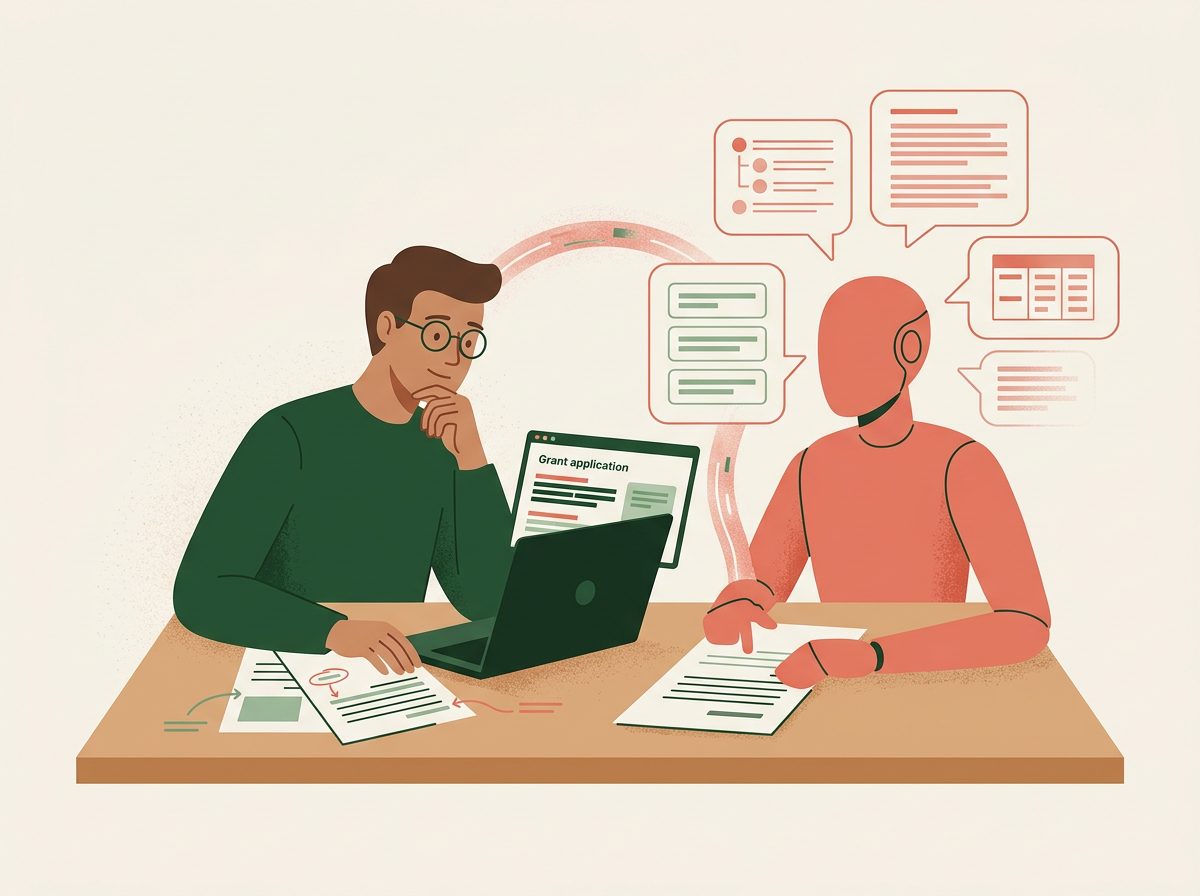
Charities often grapple with making complex terminology accessible to a broad audience, including funders. AI can be excellent at simplifying convoluted sentences, rephrasing jargon into plain English, and enhancing the overall readability of your text. This is particularly useful for ensuring your application is understood by a diverse panel of reviewers, not all of whom will be experts in your specific field.
"AI can be a powerful assistant, automating mundane tasks and freeing up your human resources for the truly impactful work of connecting with communities and crafting compelling stories."
4. Brainstorming and idea generation
Stuck for a new angle, a creative project idea, or a way to articulate impact? AI can act as a diligent brainstorming partner. While its ideas might not always be perfect, it can generate a range of concepts or phrases that can spark your own creativity and lead to innovative solutions.
The danger zones: Where AI can go wrong (and why)
Just as there are areas where AI excels, there are critical domains where its use can be detrimental to your grant application and, by extension, your charity's reputation. Navigating these 'danger zones' requires a keen understanding of AI's limitations and a commitment to maintaining a human-centred approach.
1. Articulating beneficiary voice and lived experience
This is arguably the most critical area where AI falls short. Genuine beneficiary voice comes from real experiences, emotions, and perspectives. AI cannot replicate this authenticity. An AI-generated 'story' will lack the nuance, specific details, and profound emotional resonance that only lived experience can provide. Funders are increasingly looking for authentic voices and co-produced narratives; using AI here will feel hollow and can actively work against your application.
2. Funder-specific facts and nuanced requirements
AI models are trained on vast datasets, but they aren't 'aware' of your specific charity, your unique relationship with a funder, or the precise, often unwritten, nuances of a particular grant programme. They cannot accurately recall your charity's unique track record, previous project outcomes with that specific funder, or the subtle emphasis a funder places on certain aspects of their criteria beyond what's explicitly stated in a general guideline. These details require human knowledge, institutional memory, and careful review of funder documents.
3. Final polish and strategic messaging
While AI can help with grammar and readability, it often struggles with the strategic polish that makes an application truly compelling. It might miss opportunities to strengthen your charity's mission alignment, emphasise key achievements, or strategically frame your ask. The final narrative cohesion, flow, and persuasive power come from human insight, not algorithmic generation. An AI might produce text that is technically correct but lacks soul and persuasive force.
4. Maintaining ethical standards and data privacy
When using AI tools, especially those that process text, you must be extremely cautious about what information you input. Grant applications often contain sensitive data about beneficiaries, staff, and project details. Feeding this information into third-party AI models can pose significant data privacy risks and potentially breach GDPR regulations. Always ensure you understand how the AI tool uses and stores your data, and avoid inputting any confidential or personally identifiable information.
| Task Area | AI Strength | AI Weakness |
|---|---|---|
| Research | Rapid data synthesis, trend identification | Lacks nuance, can't verify accuracy of sources |
| Structure/Outlining | Provides logical frameworks, suggests headings | Doesn't understand unique project context, can be generic |
| Language/Editing | Plain English, grammar, readability, summarisation | Lacks voice, strategic persuasion, cultural sensitivity |
| Beneficiary Voice | No strength | Cannot convey authentic lived experience, risks de-personalisation |
| Funder-Specific Detail | No strength | Unaware of funder history, specific requirements, or relationships |
Practical steps for integrating AI responsibly
To harness the power of AI without falling into its traps, a structured and cautious approach is essential. Think of AI as a capable assistant, not a replacement for your expertise.
1. Start small and experiment
Don't throw your most critical grant applications at AI from day one. Begin by using it for less critical tasks, such as drafting internal reports, summarising long documents, or generating different ways to phrase common project descriptions. This allows you to understand its capabilities and limitations in a lower-stakes environment.
2. Always fact-check and verify
AI models can sometimes 'hallucinate' – meaning they generate plausible-sounding but entirely false information. Every statistic, every claim, and every 'fact' generated by AI must be rigorously fact-checked against reliable sources. Never assume accuracy; always verify.
3. Maintain strict confidentiality
As discussed, avoid inputting any personal data, sensitive project details, or confidential organisational information into public AI tools unless you have explicit guarantees about data privacy and processing. Consider using local, open-source models or enterprise-level solutions if handling sensitive data is a necessity and you have the technical capacity.
4. Prioritise human review and editing
Every piece of text generated by AI, no matter how good it seems, requires a thorough human review and often significant editing. This isn't just about correcting errors; it's about injecting your charity's unique voice, ensuring strategic messaging, and adding the emotional resonance that only a human can provide. Treat AI output as a first draft, not a finished product.
5. Develop specific prompts for specific tasks
The quality of AI output is directly related to the quality of your input. Learn to craft clear, detailed prompts that guide the AI effectively. Specify tone, audience, length, and key points to include or exclude. For example, instead of "write about our project", try "Draft a 200-word paragraph for a local community funder, outlining our youth mentoring project's positive impact on social cohesion and skill development, using hopeful and accessible language."
The future is human-AI collaboration
The goal isn't to replace human grant writers with AI, but to empower them. By strategically delegating certain tasks to AI, charity fundraisers can free up valuable time to focus on what truly matters: building relationships with funders, engaging authentically with beneficiaries, and crafting compelling narratives that resonate deeply. AI is a tool, and like any tool, its effectiveness depends on the skill and wisdom of the person wielding it.
Next steps
We encourage you to explore AI tools cautiously and creatively. Begin by identifying a low-risk aspect of your grant writing process where AI could genuinely assist, such as summarising a long funder report or drafting a simple project description. Always remember that the soul of your application lies in the human stories and dedication of your charity. When you're ready to refine your approach, revisit these guidelines to ensure your AI use aligns with best practices and maximises your chances of securing vital funding.